This post is about the best smart coffee machine, you won’t find any info here about stupid coffee machines, or scruffy ones, only smart coffee machines will do.
OK, I’m kidding, clearly smart coffee machine in this context doesn’t mean that it must have a Masters degree, or that it must wear a shirt and tie, of course, we’re talking about smart in a slightly different context.
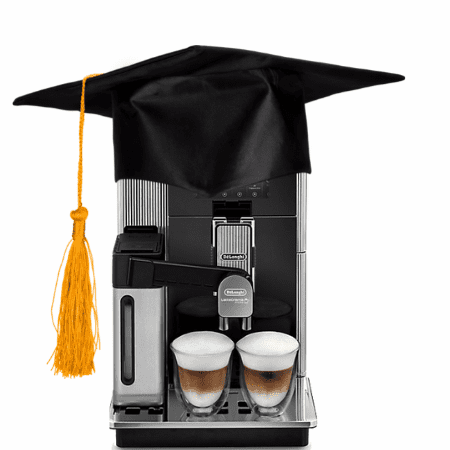
For example, fully automatic “one touch” bean to cup coffee machines will make the selected coffee drink for you. You just press the button, the machine pulls the shot, steams the milk, delivers it into your cup and even disposes of the used puck of coffee into the internal dump box for you. This is pretty smart.
The Sage Oracle and Oracle Touch are also very smart, in that they take over all of the stuff the home barista would usually need the skills to perform: dosing, tamping and getting the milk texture perfect, creating home barista quality coffees without the usually required home barista skill.
I would think, however, that many people when searching for smart coffee machines will probably be thinking along the lines of connected coffee machines that can be controlled over the internet with Alexa or Google Home, or via a dedicated app.
Actually, there are not all that many smart coffee machines in this context at the time of writing in 2022, and the ones that are smart in that sense are not necessarily the best options for making great coffee.
Jump in your time machine and go forward to a time where the coffee machine can get the cup, rinse it, warm it, get the milk out of the fridge, check if there are beans in the hopper, or put a pod in the machine, and so on, and yeah, smart coffee machines in that sense would be mega.
But right now, I think there is fairly little that connected wifi or bluetooth app-controlled coffee machines can really do, other than remote on and off and giving you certain information such as whether the tank is full or when a descale is required.
There are other coffee machines that may not be smart in this sense but that are actually incredibly smart where it matters, and that actually do all the things smart machines do and more, just without a wifi or bluetooth connection.
So for that reason, I am going to suggest a mix of machines including connected coffee machines and machines that I think are really smart where it matters and may be worth considering regardless of whether they are smart in the sense you were initially thinking.
For this reason, I am going to explain each type of coffee machine and then give you my recommendations for the best smart coffee machines in that category.
In other words you are not just searching for a smart coffee machine, you are searching for a smart filter coffee machine or a smart bean to cup coffee machine, and so on, so if you choose your machine just based on connectivity, you may end up with a machine which is not capable of making the kind of coffee you want to drink.
So below you will find an introduction to the various different kinds of coffee machines, followed by suggestions for the best smart coffee machines for that kind of machine.
Fully manual traditional espresso machines
I very much doubt this is the kind of coffee machine you have in mind when searching for “smart coffee machine”, but I’ll include it anyway so that you know what all of the options are. Fully manual machines have a lever, and a piston to create the pressure. This direct mechanical action gives you total control over the extraction, letting you adjust the pressure profile by feel as the shot pulls.
The most well known fully manual espresso machines are the LaPavoni Europiccola, even if you don’t know these machines by name, you’ll know them by sight, as you’ll have seen them in the background of various different movies & TV shows, often to help build an air of sophistication and luxury.
For more on the La Pavoni lever espresso machines, see:
La Pavoni Europiccola Review
You’re not going to find a La Pavoni lever espresso machine with smart features, and the same is true of other old-school coffee machines. However, if the main thing you want to do is to remotely turn your coffee machine off and on, then there’s another solution.
For me this is one of the most valuable “smart” properties of any coffee machine, to be able to remotely turn it on so that it’s hot when you get to it, makes perfect sense. If you can wake up, reach straight for your phone and turn on your coffee machine, that is a feature most of us would appreciate, especially if we have a coffee machine that takes 10-15 mins or longer to heat up.
If your coffee machine has a traditional on/off rocker switch, then there’s a really easy solution. Leave the switch on the coffee machine in the on position, and connect it to a smart plug, like this:


Check Price - Amazon UK
This inexpensive Wifi smart plug, enables you to turn even the most old-school coffee machines into smart coffee machines at least where remote on and off is concerned.
As long as your coffee machine has a standard on/off switch, as the La Pavoni machines do, and as the original pre 2009 Gaggia Classic does, for example, you can remotely turn them off and on via this smart plug.
You benefit from this with the original Gaggia Classic, and the La Pavoni Europiccola, basically any machine with a standard on/off switch so you can leave it on the on position and control the power via the smart switch.
If you have a more modern coffee machine, however, that doesn’t enable you to leave it switched on, this is still doable, but you’ll need something a bit more “A-TEAM”, like this:

Check Price - Amazon UK
This is a genius idea, you can stick it onto just about anything, connect to it with your smartphone, turn it on and off remotely, even set up timers so that it automatically turns on and off at the pre-set times.
I came across these a while ago in a reddit thread, someone was using one to turn on a coffee machine which wouldn’t work with a smart switch as it didn’t have a traditional rocker on/off switch, and I thought it was a great idea!
As I said earlier, there isn’t a great deal you can really do with connectivity and coffee machines other than remotely turn them on and off. It would be very difficult to use your smartphone to fill up the water tank or empty the drip tray.
So with a smart plug or a smart switch, you can actually make just about any coffee machine “smart” in the one area that it really does make sense.
If you find a way to make coffee machines do the other important stuff after turning on, such as washing cups, emptying drip trays, filling bean hoppers and so on, then please do let me know! ;-).
Semi-automatic traditional espresso machines
The vast majority of traditional espresso machines these days (well, not just “these days” but for the past few decades) are semi automatic, which when it comes to traditional espresso machines, means that they have a pump for creating the required pressure.
So with these kinds of machines, you have a separate grinder with which you grind the coffee beans into the filter, which sits in the filter holder (known as the portafilter), which you insert into the group head, and then you press the shot button, the pump is engaged and the shot of espresso is pulled.
This kind of espresso machine will (nearly) always have a steam wand for frothing and heating the milk for cappuccino, latte, flat white and so on.
The best smart semi-automatic espresso machines
As I’ve mentioned above, you can actually turn any semi-auto espresso machine into a smart espresso machine when it comes to remotely turning it on and off, via a smart plug or smart switch.
The semi-auto espresso machines I’m about to introduce you to are smart in the true sense of the word, for the reasons I’ll explain for each machine, and with the combination of a smart plug or smart switch, you can also make them connected in terms of being able to remotely turn them on or off.

Check Price - Amazon UKCheck Price - Sage Appliances
The Sage (known as Breville outside of Europe) Bambino plus is among the entry level espresso machines from Sage.
This is a cracking little espresso machine, which can be used for home baristas, or for complete beginners who have no interest in the home barista hobby.
Just to delve a bit deeper into that, using an espresso machine as a home barista, means using traditional filter baskets and a grinder capable of grinding fine enough and making adjustments small enough in order to be used for espresso machines with standard baskets.
It means spending time and effort “dialing in” which is mainly (but not purely) about adjusting the grind, in order to get the extraction as close to perfect as possible. It means weighing the dose, and the espresso, and there really is a learning curve to this kind of home espresso making.
The cheaper (usually around £100-£200) machines which are marketed as espresso machines, are slightly different, as they’re aimed at people who like the idea of using what appears to be a traditional espresso machine, but without the required skill.
These machines usually “boast” (fake boast, as this isn’t something to boast about) 15 bars or even 19 bars of pump pressure, and they usually come with pressurized baskets, not standard baskets.
Some of the entry-level home barista espresso machines, including the entry-level machines from Sage, come with both standard baskets and pressurized baskets (Sage call them dual walled baskets), so if you prefer, you can use the dual walled baskets & this reduces the importance of the griner quality and home barista skill.
You can even use pre-ground coffee with these baskets, but I’d highly recommend that you grind your own, even if you’re using pressurized baskets, as freshly ground coffee is much fresher.
As I found with some blind taste testing, you can actually get pretty close with the dual walled baskets when it comes to espresso quality, as you can with putting time and effort into dialing in with standard baskets.
So as far as I’m concerned, if you want to use a traditional espresso machine but you’re not yet convinced as to whether you want to go the whole home barista hog, a machine like this which comes with both types of baskets and therefore gives you the option, is a good idea.
The smart bits
3 second heat up time.
With this machine, you really don’t need the auto-on feature or scheduled on and off times, as it literally takes 3 seconds to be ready to use. You’ll want to run some water through the group before you pull your shot, in order to warm up the group head, the portafilter and your cup, but you’d need to do this with most espresso machines.
Auto milk texturing.
One of the hardest things to do when it comes to making great espresso based coffee drinks at home, is to get the milk texture right. Baristas and seasoned home baristas make it look much easeir than it actually is!
With the bambino plus, though, you just fill the the jug, put it on the drip tray making sure it’s covering the heat sensor, and the machine will texture the milk to your pre-set froth and temperature settings. You can steam milk manually if you prefer, and it does a great job of texturing that way too, once you’ve got the knack of it.
Automatic factory pre-set pre-infusion.
Pre-infusion means introducing water to the ground coffee under reduced pressure. With the Bambino plus (with all the Sage espresso machines in fact) the pressure slowly increases up to the 9 bars of pressure after the preinfusion phase.
9 bars of pressure.
As with most espresso machines, the Bambino plus has a 15 bar pump, but unlike most of the cheaper domestic machines, it has an overpressure valve set to 9 bars of pressure, which is generally accepted as the standard for espresso.
3 way solenoid valve.
As with the OVP (over pressure valve) and pre-infusion, a solenoid valve is something you’d usually expect in commercial machines or home barista espresso machines, the majority of lower cost home espresso machines wouldn’t usually have a 3 way solenoid.
The benefit of this is that the leftover pressure and water is expelled via a tube from the solenoid into the drip tray, so you’ll usually have a nice dry puck, and if you choke the machine with too fine a grind, you don’t get what’s known as portafilter sneeze if you remove the portafilter from the group without allowing the brew valve time to get shot of the pressure.

Check Price - Amazon UKCheck Price - Sage Appliances
The smart bits
The Barista touch, again from Sage Appliances, is smart in the same ways as the Bambino plus above, but it also has:
Integrated grinder
The Barista touch has an integrated grinder with 30 grind settings. What this means is that you don’t need a separate grinder, but (unlike bean to cup machines) you have at least some ability to dial in.
You don’t quite have as much dialing in ability as you would with a stand-alone espresso capable grinder, though, especially not compared with the likes of the Eureka Mignon (which has a worm dial for infinitely fine adjustment).
For more on Eureka Mignon grinders, see:
Eureka Mignon Review
Having an integrated grinder doesn’t make the Barista touch a bean to cup coffee machine, by the way – although to be fair, the Barista touch is straddling the line between traditional espresso machines and bean to cup coffee machines with its touch screen settings and auto milk steaming.
Touch screen controls.
The Barista touch has, as the name would suggest, a touch screen. This allows you to swipe through and select your coffee, and also to change the drinks, and to add new ones. When you choose your drink, the screen will talk you through what to do to make the selected coffee.
This is similar to the Sage Oracle Touch, only it’s just the milk side of things that are done for you with the Barista touch, as this machine doesn’t quite have the same level as smartness when it comes to the espresso side of things as the Oracle Touch has, with it’s auto dosing & auto tamping.
Auto milk texturing.
The Bambino plus does have this too, but it’s a bit more advanced with the Barista touch, with more control over the milk texture and temperature and the controls being via the touch screen.

Check Price - Amazon UKCheck Price - Sage Appliances
I know I’m starting to come across as a real Sage fanboy ;-), but they really do make some of the smartest espresso machines. They do things differently from the way most manufacturers work when it comes to designing domestic coffee machines.
They’ll look at the way other manufacturers do things, and instead of just following suit, they’ll often invent new components or new ways of doing things in order to do a better job.
The dual boiler is a great example of this. The obvious approach to making a higher-end espresso machine would have been to make a dual boiler machine or a heat exchanger (which heats the brew water via a pipe running through the steam boiler).
Instead, they created a (the first, that I’m aware of, at least when it comes to domestic machines) dual boiler machine, also with a heat exchanger for the purpose of improving thermal stability.
The smart bits
Auto on.
Just go into the menu, and select the time you want it to turn on. This is great for having it turned on and heated up each morning of course, but also, each time you use it you can very quickly go into the menu and tell it to turn back on again 5 or 10 minutes before you’re going to want your next coffee.
Ultimate temperature control
It’s not uncommon to have two or three brew temp settings, but with the dual boiler, you have 10 settings, in 1C increments from 86C – 96C, very simple to change via the control panel, which gives great control when it comes to really precisely dialing in with a wide range of roast profiles.
Amazing preinfusion control
Not only do you have control over the pump power when it comes to pre-infusion, being able to adjust both the preinfusion power and the preinfusion time gives you rare flexibility over the preinfusion.
Unparalleled (at this price point) temperature stability
One of the keys to great espresso is temperature stability, and temp instability is the Achilles heel of many lower-cost espresso machines.
What they’ve done with the dual boiler, without getting too technical, basically means that the machine performs as if the group was one with the boiler, which is known as a Saturated group.
It’s not, and saturated group machines are something I’d expect on much higher-end machines and some commercial espresso machines, but it acts as if it is, due to the pid controlled heated group, and the pid controlled brew boiler, which work together to deliver the exact brew temp required by the user.
Loads more…
I could go on and on about the Dual boiler, I have this machine, in fact I have two of them. I have one at home as my main home espresso machine when I’m not using other machines to review, and then I have one in the studio, and having two means I can mess about with one of them.
For instance, my silver one (I have a silver one and a black one) now has the “slayer mod” a very simple mos which allows me to use the water knob to control the pressure on the fly, allowing me to do “flow profiling”, which I won’t get into within this post, but just take my word for it, this is one chuffing smart espresso machine!
For more, see:
Sage Dual Boiler Review
That’s it for my suggestions for semi automatic espresso machines, but for loads more suggestions, see:
Best Espresso Machines
Bean to cup coffee machines
Most people when searching for the best smart coffee machines, I reckon, probably have bean to cup coffee machines in mind, so for this reason I’m going to focus most of my suggestions on bean to cup coffee machines.
These are usually espresso machines (not always, there are some bean to cup filter coffee machines) and they have an integrated grinder & a brewing unit (which handles all of the espresso-making), an internal grinds container (into which the used pucks of coffee are expelled, for you to dump when full), and most of the time, a way to froth milk.
There are “one-touch coffee” bean to cup machines or “semi-auto” bean to cup machines that handle the coffee for you as a one-touch affair but which have a steam wand (usually what is known as a Panarello or turbo frother).
There are also “one-touch milk” machines sometimes also known as “cappuccino makers” which also handle the milk frothing at the touch of a button, so you just press a button and walk off with your cappuccino or latte for example.
The best smart semi-automatic espresso machines

Check Price - Amazon UK
Melitta is a well-known coffee machine manufacturer that has been around quite some time, and they make some very popular domestic bean to cup coffee machines, in addition to making commercial bean to cup coffee machines.
The smart bits
This is a relatively inexpensive bean to cup coffee machine, especially considering it’s a one-touch, carafe machine, which are usually more expensive.
Many of the features are just what I’d expect to see on a one-touch, fully automatic bean to cup machine, but this is also a smart coffee machine in the sense that it’s “connected”, via the Melitta Connect App.
This app allows you to:
Access tutorials
Yeah, not really that impressive – I have youtube for that, next…
Amend and create drinks
There are an impressive 21 different drink selections in total and 8 user profiles, and you can edit and create from the smartphone app.
Make coffee
This is a fairly impressive feature on the face of it, but, and it’s a fairly big but, you have to turn it on manually to make coffee via the app. Hmm.
Theoretically, you could use a smart plug or smart switch as I mentioned earlier, to turn it on remotely and then use the smartphone app to make coffee, but it seems a bit of an error to me that they’d make a “smart coffee machine” which is smart enough to make coffee from the app but only after you’ve walked up to it to turn it on.
The manufacturer have probably figured that this doesn’t really matter because you can’t use an app to put the cup on the drip tray, put milk in the carafe and so on, but in that case what’s the point of being able to make coffee from the app?
The machine will turn itself off after 15 minutes, so it’s not like you only have to turn it on once and then at any time you can make a coffee from your phone as long as there’s a cup and the milk carafe is in place.
But, if you could turn it on with the app then in theory you could leave a cup on the drip tray the night before and at least make an espresso or Americano, for instance, from your smart phone – or if there’s someone else up and you can’t be bothered getting up, you could ask the less lazy person to put milk in the carafe and stick it on the machine, and then bring you your coffee ;-).
Yes if there’s a less lazy person already up, they could turn the machine on too, but you can only operate the machine from your phone once the machine has heated itself up and rinsed itself, so there’s a bit of a wait once it’s been manually turned on.
Split hopper
OK we’ve moved on from the app stuff now, and I’m including this feature as it’s rare, but actually, it’s not really a feature I rate. The simple reason is that while this is marketed as being a dual hopper machine, this is just one hopper split in half.
Yes in theory you could put one type of bean in one half and another in the other half (such as full caff and decaf) but bean hoppers are among the worse places to store coffee beans, you’re way better off just grabbing a handful (or better still, weighing the approx amount of beans you’re about to use) and lobbing them in the hopper.
The not so smart bits
Reading through the Amazon reviews they’re largely really positive, but there are a few people who’ve had issues with connectivity, with a couple of people saying the app disconnects often, which I’d find frustrating if I’d bought the machine partly down to the connectivity.
There are also a few people complaining about the milk temperature, although there are some people saying the opposite where max milk temp is concerned so it could just be that some people have had defective models, it happens.
As I’ve mentioned, the biggest oops for me is the fact that one of the biggest features, in theory, being able to make coffee remotely, is only really a gimmick due to the fact that you – or someone – would have to walk up to the machine first to turn it on, unless you use a smart switch.

Check Price - Amazon UK
This is Brad Pitt’s coffee machine, and if you believe that you’ll believe anything ;-). It’s the coffee machine he uses in the latest (at the time of writing) commercial featuring Brad Pitt.
The smart bits
This is another app-controlled smart coffee machine, and with the DeLonghi “Coffee Link” app, which allows you to do quite a bit, to be fair, including:
Turn it on
Once the machine is setup, you can turn it on from your smartphone, via the app.
Discover
You can discover stuff via the Delonghi coffee link app. I’m not sure what you can discover, I’m just reading through the instruction manual, it just says “discover”, I’m assuming this is coffee-related discoveries.
Manuals & Help
You can access manuals for your coffee machine, and access help directly via the smartphone app.
Adjust the 16 beverages
This machine comes with 13 pre-set coffees, and you can add another three via the app, all of which can be controlled via the app.
Custom profiles
There are three custom profiles with this machine, which can be set up and accessed via the app.
Initial setup
Once you’ve turned it on, filled the water tank & put beans in the hopper, the initial setup can all be controlled via the app, and the main machine settings are available via the app if you need to change them in the future.
Overall then, this looks pretty good. I think the fact that you can actually turn the machine on from the smartphone app is a positive.
As long as you remember to put a cup on the drip tray the night before, in theory as long as you don’t want milk (as there’s currently no app smart enough to get the milk out of the fridge), you can turn the machine on as soon as you wake up (or just before, if you’re really clever), and then order a coffee from your phone as soon as it’s warmed up.
The milk thing, by the way – there are machines that come with milk fridges, but currently, these are just commercial bean to cup coffee machines, as far as I’m aware. If you had a bean to cup machine with a milk fridge, with this kind of app connectivity, you could wake up and order a cappuccino or latte, which I think would make this feature a lot more interesting to a lot more people.
The not so smart bits
In theory, I can’t really see many issues with this machine, there are no glaringly obvious issues such as allowing coffee preparation from the app but only once you’ve got up off your backside and turned it on.
There are, however, a number of recurring mentions in the Amazon Reviews concerning the milk temp at the hottest setting being only warm & not hot.
Whether this is just the occasional person like my dad who likes his milkies hotter than the center of the sun, or whether it is an issue with the machine, I can’t be certain, but if you like really hot milk in your milkies you may need to forget one-touch carafe machines and go for a machine with a manual steam wand which gives you total control over milk temp.

Check Price - Amazon UK
Seimens make a number of bean to cup coffee machines, the most popular of which appear to be the “connect” range, with the Home Connect app.
Via this app, you can do the following:
Remote start
Once you’ve enabled it remote start, you can use the app to turn on your coffee machine.
Make coffees
Once the machine is ready, you can select, modify and prepare coffees from your smart phone via the app.
Queue up drinks
With the “coffee playlist” feature, you can take orders from your guests or family, to be then made one after the other. Clever!
Coffee World
Select coffee drinks from a selection of app-exclusive specialities from around the world. I’ve actually downloaded the app, as you can use it in demo mode as if you have this machine, and this coffee world feature is very interesting. It includes very speciality drinks such as Keliener Brauner, Weiner Mrlange & Kaapi, so it’s not just the usual suspects.
Childproof Lock
You can activate and deactivate the childproof lock via the app, handy if you have kids who’ve grown tall enough to reach the machine!
Switch off timer
In theory, you can select a wide range of auto off times via the app, from 5 mins to 3 hours. I say in theory, as I’m going from the demo app, and I’m not sure if all of these times will be accessible in all countries.
The EU regulation (that the UK still appears to be operating under at the moment from what I can gather?) for auto-off times on domestic coffee machines is 15 minutes, so whether or not you’ll have the full functionality as per the demo version of the app, I’m not sure, but I will try to find out & I’ll update this accordingly.
Milk first or coffee first
In the Home Connect settings, you can toggle between milk first or coffee first for cappuccino, which is a rare level of control.
So I have to say, if this app works as it’s designed, I think the Seimens bean to cup machines possibly take pole position when it comes to the smartest bean to cup coffee machines. The world coffee selections and the coffee playlist, I think are really clever features that are actually usable, not gimmicks.
The not so smart bits
The only negatives I can find for this machine is the same old “milk isn’t hot enough” issue that tends to be a common one in reviews with one touch bean to cup machines. Other than this, I’ve found mention of the app being a bit clunky to use, but when I used the demo app it seemed fairly slick, so I’m not sure if they’ve updated the app, or if the “clunkiness” refers to pairing, which I wouldn’t know about as I’ve only used the demo version.
For more bean to cup coffee machines, see:
Best Bean to Cup Coffee Machines

Check Price - Amazon UK
This is the latest version of the De Longhi Magnifica, I’ve reviewed the earlier version, the De’Longhi Magnifica S – and this is the updated “smart” version of this machine.
I’ve tried this machine, and I’ll be reviewing it very soon, in the meantime though just see my original De’Longhi Magnifica S review, as it’s practically the same machine.
The smart bits
This machine isn’t a smart coffee machine in the sense that it’s connected via an app or Alexa, etc. As I’ve mentioned earlier, there’s nothing stopping you from turning this machine on and off remotely via a smart switch, but if you’re looking for a machine you can make coffee from remotely, then this isn’t it.
It is a fairly smart coffee machine in the more general sense, though, although ironically I can’t really see what’s smart about it in comparison to the “non-smart” version.
Other than a couple of purely aesthetic differences, the only thing I can really see that I think is better with the “smart” version, is the panarello steam wand. The original “non-smart” version has a more standards panarello wand, while the Smart version has the same adjustable wand as with the De’Longhi Dedica, which I think is possibly the best version of these kind of wands that I’ve seen.
Cheap as chips
For a bean to cup coffee machine, this really is a cheap machine, and this and the original Magnifica-S I think are a lot of bean to cup coffee machine for this kind of money.
Simple to use
This machine is very straightforward to use. My mum has one – and not that I’m calling her simple ;-), but I think this is the first machine she’s had of this type, and she’s had no problem using this machine after a very quick bit of instruction.
Great panarello
As I’ve mentioned, this “Smart” version has an adjustable panarello, the same one as you’ll find on the De’Longhi Dedica EC685. In case you’re wondering what a panarello is, it’s a milk frother which consists of a sheath placed over the steam pipe, which automatically froths milk without any skill requirement.
Using a “proper” steam wand to foam milk isn’t quite as simple as Baristas make it look, I can tell you this from personal experience! It took me years to learn to properly texture milk with a steam wand. A Panarello wand, AKA turbo frother, requires very little skill, and produces the kind of froth many people are happy with.
Bean to cup coffee machines with this type of wand are usually the cheapest, with one touch cappuccino machines having milk carafes, being the most expensive usually, but I actually think panarello wands are way better on the whole.
The reason I say this is that the nunber one complaint from people who have one touch bean to cup machines, is milk temperature not being hot enough. With a panarello wand, although you don’t usually have great control over the texture, you have great control over the temperature, you can literally just keep going usually until the milk is at the temp you desire.
With this particular panarello, though, you have two settings – cappuccino, and hot milk. What this means, is that you can leave it on the cappuccino setting for as long as you want to inject air, and then simply change it to the hot milk setting to just continue heating but not aerating, and this gives you not only conrol over the temperature of your milk, but also the texture.
With most bean to cup machines with a panarello wand, though, you can also remove if it you wish, and use the steam pipe beneath as if it were a pro steam wand.
The not so smart bits
I’m not sure why they’ve called this “smart”
Given there’s already a Magnifica S, I would have imagined that the Magnifica S Smart version would be smart in terms of connectivity, and I’d think that many other people would think this too. This is an updated version of the Magnifica S, with a few design tweaks and the better (in my humble opinion) panarello wand, and I can’t quite figure out why they decided to name this version Smart.
Double shots aren’t double shots
I’ve mentioned this before when talking about the Delonghi Magnifica machines and other DeLonghi bean to cup machines, I do wish that a double shot would produce double the volume of espresso made with double the ground coffee, for a true double shot.
With all of the Gaggia bean to cup coffee machines, for example, if you press the shot button twice in quick succession, the machine grinds and pulls the shot twice, so you end up with double the espresso from double the ground coffee.
I did some experimenting with the Magnifica S and from what I can gather, the machine either grinds the same or maybe ever so slightly more coffee for a double shot, and then produces a larger, weaker shot.
It’s not a deal-breaker though, if I wanted a double shot from this machine I’d just press the single shot button, and then press it again once the first shot is pulled.

Check Price – Gaggia Direct
This is one of the latest bean to cup coffee machines from Gaggia, and it’s an impressive machine, with five versions:
Cadorna Style
This is the base version, plastic panarello steam wand, 6 different coffees.
Cadorna Plus
The same as the style but with stainless steel panarello steam wand, 6 different coffees as with the style.
Cadorna Milk
This comes with a cappuccinatore milk frother instead of a panarello wand, 10 different coffees.
Cadorna Prestige
This is the milk carafe version, and has settings for 16 different coffees.
Cadorna Barista Plus
The model pictured above, this is the same in features as the plus, but it has a pro steam wand.
The smart bits:
4 user profiles
This is one of the main features that makes the Cadorna unique compared to other Gaggia machines, with four distinct user profiles with different colours. These machines are made for up to four users to be able to customize all of the coffees for them.
Easy to control coffee strength
It’s often quite difficult to know what strength settings actually relate to with some bean to cup coffee machines. One of the things I really like about the Gaggia machines is that you always know how much coffee is being ground depending on your strength selection, with the “bean” settings.
On machines such as the Cadorna which have 5 strength settings, the one bean setting is 7 grams, and then it goes up in one gram increments, with the 5 bean setting representing 11 grams. On machines including the Gaggia Brera, which have three bean settings, the min and max are still 7 and 11, but there’s just one setting in between, which is the 2 bean setting which results in 9 grams of coffee being ground.
Filter coffee machines
As the name would probably suggest ;-), and as you’re no doubt aware, filter coffee machines are machines that make filter coffee.
They have a filter basket in the top, into which you insert a filter (or you can use the reusable mesh filter that many of them come with), and put ground coffee into, which hot water then enters, filters through the coffee and drips into the pot.
If you’re into filter coffee, then you really should be looking for a filter coffee machine. I say that, because I hear from people occasionally who’re not happy with their coffee machine simply because they’ve misunderstood “similar” types of coffee to be the same.
A common one is that people like filter coffee, and they buy a bean to cup espresso machine, thinking that espresso mixed with hot water is the same thing as filter coffee.
This is Americano, or long black, and it may be similar in strength and in volume, but it’s definitely not the same, it has a different mouth feel and a different taste. The same is true of cafetiere coffee, for example, it’s similar, but it’s not the same.
So if filter coffee is what you crave, and you’re wanting the convenience of a coffee machine vs manual brewing, then you need to be specifically looking for a filter coffee machine.
The best smart filter coffee machines

Check Price - Amazon UK
This is a bean to cup filter coffee machine, so it’s a filter coffee machine with an integrated grinder.
The “smart” bit is due to the fact that you can control this coffee machine via app, and also via Alexa, Google Nest & Siri.
The smart bits
Coffee via voice command
The fact you can c0nnect this machine to Alexa, Siri & Google Nest, means you can bark commands at it, although as far as I’m aware it’ll only respond to coffee-related commands.
Brew coffee from anywhere
You can turn the machine on via Alexa or other apps, and order freshly ground freshly brewed coffee, as long as you’ve remembered to put a cup in place and fill the water tank on.
The not so smart bits
I can’t really see any major flaws with this machine, but reading through the Amazon reviews, although it’s largely positive as you can tell by looking at the overall review score, if you trawl through the single star reviews it doesn’t paint a pretty picture, with quite a lot of failures reported.

Check Price – Amazon UKCheck Price – Sage Appliances Check Price – Currys
This isn’t a “smart” filter coffee machine in the sense that it’s connected via a Bluetooth app or Alexa, and actually there are very few filter coffees that are, at the time of writing, but this is a very smart filter coffee machine in the broader sense of the word.
The smart bits
Big capacity
You can brew up to about 1.7 of coffee with this machine, which is about the biggest volume you’ll find from a domestic filter coffee machine.
Cold coffee…
It’ll make hot coffee too of course, but the Sage Precision brewer has a cold brew function.
Temperature stable
It has a PID which means that the brew temp is under control.
Multiple brew settings
There are various brew settings including “Gold Brew” which automatically makes you a coffee using the SCA-approved standards.
Stainless steel carafe
One of the common gripes about filter coffee machines is the glass carafes can break, and they’re often quite expensive to replace, compared to the price of the machine. This is a stainless steel carafe, and it’s insulated which means it keeps your coffee warm, too.
Auto brew timer
You can set it to wake up before you do, and brew your coffee for you. Obviously you’ll need to grind your coffee and load the filter basket the night before.
The not so smart bits
The only obvious one is that it costs more than many people would think of spending on a filter coffee machine.
For more filter coffee machines, see:
Best Filter Coffee Machines
Pod coffee machines
Again, I’ll be preaching to the converted here, you won’t need me to tell you what a pod coffee machine is.
Pod coffee machines all started with a chap called Eric Favre, a Swiss fella who had a bit of friendly spousal banter with his Italian wife about Swiss coffee vs. Italian coffee, which turned into a challenge that led to him inventing what became the Nespresso machine.
Eric played the long game with his invention, he even began working in the packaging department of the Swiss headquarters of Nestlé, just to get his foot in the door.
It wasn’t until several years later when he’d worked his way up to being a food scientist for Nestlé, that he pitched the CEO of Nestlé Japan, on an assignment there, that Nespresso was born.
About 30 years later, the same clever bloke also invented what we know as the Lavazza pod machine. Anyway, Nespresso were the first pod machines, of course there are quite a few others now, including the aforementioned Lavazza, plus Tassimo, Dolce Gusto & the newer Nespresso Vertuo.
The best smart pod coffee machines

Check Price – Amazon UK
This is one of the aforementioned Lavazza machines, invented by the same guy (well, the system he invented was licensed to Lavazza) who invented Nespresso.
He initially did it, apparently, because he felt so bad about the amount of damage potentially being done to the environment by the requirement of Aluminium in Nespresso pods, although there are many Aluminium free, recyclable, and even compostable Nespresso compatible pods these days.
The smart bits
Coffee via voice
Given the name, it would be quite funny if this wasn’t a machine that you could make coffees with via voice command ;-). This is a collaboration between Lavazza and Alexa, it comes with Alexa in-built.
Morning routine
Not only can you ask Alexa to make your coffee, you can setup a morning routine which involves your lights being turned on if you also have Alexa controlled lamps or light bulbs, an your coffee being ready for you!
Reorder pods
If you tell Alexa via your Lavazza machine how many pods you have left, and setup an auto order at a certain level, she’ll even order your pods for you when you’re running low.
The not so smart bits
The obvious one is that the voice command coffee is mainly a gimmick, as you have to walk up to the machine to put the pod in.
Alexa won’t (yet) reach for the pod and load it in for you. With this in mind, you might decide that a much cheaper Lavazza machine which is similar in the other features, such as the Deséa, may be a better bet.
I think the morning routine thing is great, because you can just slap a pod in the night before, and as long as you remember to put the cup in place, you’ll have coffee when you get to it as long as you remembered to say Good Morning to Alexa, but the voice-controlled coffee I can see being something you use to entertain friends and family, but that’s probably about it.
I’ve also read a few complaints in the Amazon Reviews referring to the voice control not working particularly well, and having to repeat yourself numerous times, which reminds me of watching my father-in-law’s hilarious arguments with Alexa, in which he repeatedly shouted “ELVIS” at the Alexa, forgetting to say Alexa first ;-). There are probably people like my father-in-law just shouting “COFFEE!” ;-).
It’s also possibly a bit more pricey than many people would be expecting to spend on a pod coffee machine, and there are much cheaper Lavazza machines which have similar features but are just lacking the “smart” features in the form of the Alexa controls.

Check Price - Amazon UKCheck Price - Sage Appliances
This is an original Nespresso machine, from Sage (Breville outside of the UK) – it looks similar to the Bambino plus, and has some similar features.
The smart bits
Big water tank
The water tank is 1.5L, which may not sound huge, but this is fairly bit when it comest to pod coffee machines.
Auto milk texturing
As with the bambino plus, you can just put milk in the jug, put it on the temp sensor, and the machine will texture the milk to your chosen froth level, and heat it to the desired temp.
Auto purging steam wand
The steam wand automatically cleans itself when you push it back down into place, as with the Sage Bambino Plus.
3 second warm up time
Again, as with the Bambino Plus, the creatista Uno is ready to go in just 3 seconds.
The not so smart bits
It has a similar sized drip tray to the Bambino plus, and to be fair it’s probably quite big for a Nespresso machine, but the auto purge will take up a fair amount of drip tray space, so if you’re making milkies you’ll probably have to empty the drip tray fairly regularly.
The other obvious point is that the price, it’s a few hundred quid, which for many people is probably about three times more than they were expecting to pay for a pod coffee machine.
For more on Pod coffee machines, well, you know the drill by now 😉 …
Best Pod Coffee Machines
Kev’s Smart Coffee Machine FAQ
Are smart coffee machines useful, or just a gimmick?
I think this really depends on what the “smart” coffee machine you’re looking at actually does within these smart features.
Some smart coffee machines for example offer remote features which would lead you to think you can use them from the comfort of your bed, for example, but they don’t have a remote turn-on feature, so you have to get out of your pit to go & turn it on, which would render the feature fairly useless.
I also think it depends on the type of coffee machines. With pod coffee machines, for example, you’re always going to have to put a pod in the machine, which makes the main “voice control” aspect of using a machine like this, no more than a gimmick if you ask me.
Having said that, if you have a pod coffee machine with a morning routine that will turn your lights on and make your coffee from the pod you loaded the night before when you say good morning to it, then for me, that’s a real, usable feature and not just a gimmick.
What does a smart coffee machine do?
This depends, really, on what exactly you mean by “smart”, and the type of coffee machine, and the specific smart coffee machine in question, as there’s no rule about what a coffee machine should do if it’s labeled as a smart coffee machine.
What I would refer to as smart, and what I’m sure you’ll be thinking of as a smart coffee machine, is one that can be operated in ways other than manually pressing buttons. The particular features will then depend on the type of machine, and the specific make & model, as you’ll have noticed from the varied features of the coffee machines above.
What makes a coffee machine smart?
Again, this does depend on what you mean. I would think that a coffee machine marketed as a smart coffee machine, would have connectivity, meaning that you can operate it via a smartphone app, and/or via Alexa, Google Home or Siri, but as I’ve explained, this isn’t always the case.
Life is like a box of chocolates, so join my Brew Time list, subscribe to my YouTube Channel, become an accredited coffee botherer (Patreon supporter), try my coffee at The Coffeeworks (use discount code coffeebotherers), follow me on Twitter & Instagram, follow the coffeeblog FaceBook page, and that’s all I have to say about that.
This article firstly appeared at
You must be logged in to post a comment.