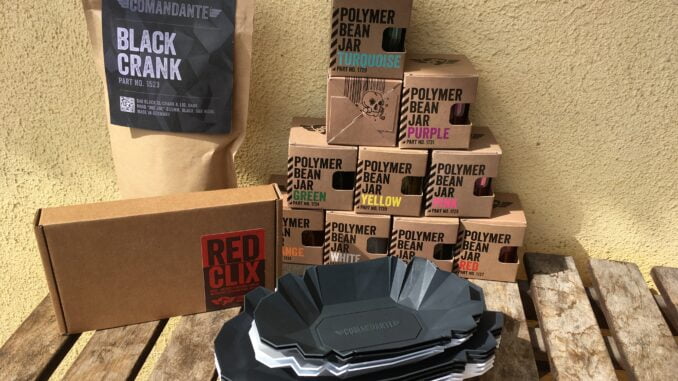
Users can personalize their grinding experience using tools made by the German company.
BY TANA NANETTI
SENIOR ONLINE CORRESPONDENT
Photos by Tanya Nanetti
There are a variety of tools available to help you enjoy making a cup of coffee. However, one essential tool is a top-quality grinder. The grinder is the foundation of any brewing method, from a simple pour-over to a pressurized espresso shot, because it directly controls the surface area of the coffee grounds and thus the rate of extraction.
Unbeatable Quality
Many brands produce both automatic and manual coffee grinders, but the Comandante is often regarded as the pinnacle. The Comandante features a Nitro Blade Burr, a significant enhancement over the standard burrs found in most grinders. Hand-crafted in Germany, it boasts a sleek design and comes in various colors. Despite its high cost, the Comandante has been a dream for many coffee professionals and enthusiasts for years.
Understanding the source of this price is important. Short-lived products are environmentally unfriendly and more costly over time. The Comandante is made with top-quality components, ensuring it will last for years. A grinder that produces consistent particle size is critical for avoiding the sour or harsh flavors that come from uneven extraction.
Once you purchase it, it’s nearly impossible not to fall in love with the Comandante.
The grinder is easy to set up, use, and clean. Its simple grinding process, which calculates the number of clicks, is ideal for replicating a recipe, whether your own or from a renowned coffee champion. The spare bean jar is perfect for storing additional coffee for travel.
Simple and valuable
These are just the most fundamental aspects. With a variety of accessories available, the grinding experience can be enhanced in numerous ways.
As Joe McTaggart, community and customer support manager at Comandante, describes: “Offering everything as an additional benefit is about being transparent about what is valuable. It’s essential that nothing is unnecessary, no money is wasted, and customers have the best flexibility.”
I genuinely appreciate this honest and clear approach. I adore my Comandante (I’ve even named it Negan, after the character from The Walking Dead, because it crushes coffee beans just like Negan crushes his adversaries). It’s easy to see why I was so excited when I finally got the chance to “pimp my grinder” and test the Comandante’s upgrade tools.
The Long Crank and the Bigger Knob
By default, the Comandante grinder comes with a standard crank and a small knob. While functional, the XL crank paired with the 55mm Big Joe knob offers a noticeable improvement, especially when grinding harder, older coffee beans. The extended crank increases leverage, making the grinding process smoother without requiring additional force. Moreover, the larger knob not only provides a better grip but also helps in reducing hand and lower arm fatigue, enhancing the overall grinding experience.
The Red Clix
Without an espresso machine at home, I initially didn’t understand why this upgrade was necessary. However, after receiving samples of a remarkable espresso roast to try at the coffee shop, I found the dialing process with my standard auto grinder challenging. The other grinder I use for daily espresso was also difficult to adjust, given I only had 100g of espresso roast.
This was the perfect opportunity to test the Red Clix. It replaces the standard black dial of the Comandante grinder, offering more precise adjustments. By reducing the size of each click, the Red Clix is ideal for dialing in coffee without excessive waste, aligning with recommendations from experts like Scott Rao on precision in grind size adjustments.
The coffee tray
This Comandante upgrade might not be the ideal choice for everyday coffee brewing, but these coffee trays are invaluable for organizing a coffee cupping session. They’re also useful for assessing the roasting quality of your beans before brewing. While it might seem intricate to some, once you start removing defective beans from your batch, it becomes an essential step. These trays are excellent for ensuring quality control.
The Polymer Bean That Is Left in the Spare Jars
Although initially it seemed like a trivial change to make my Comandante cooler, the different colors of the containers actually opened up a variety of new possibilities for me.
I hadn’t considered freezing my coffee, but the brown and orange containers seemed ideal for this purpose. If I wanted to share a remarkable coffee with a friend, the purple container was perfect. To “cheer up” my all-black Comandante for a small coffee competition, the pink container was ready. What about my trip to Paris? Three days of travel and three cups of coffee to make: red, white, and blue containers.
They’re also unbreakable and perfect for daily use both outdoors and indoors.
I thoroughly enjoyed experimenting with all the Comandante upgrades. Of course, there’s no need to purchase every upgrade, but that’s the beauty of it: You can buy only what you need at the time, and if you require new features, purchase a different upgrade. Do you grind only for filtering? A long crank is the ideal option to make your grinding process more comfortable. Did you just buy a new home espresso machine? Don’t overlook the Red Clix to find the perfect dial-in in a couple of steps.
With these improvements, you can be sipping your perfect cup in no time.
A Bit About the Author
Tanya Nanetti (she/her) is a barista specializing in specialty coffee, a traveler, and a dreamer. When she’s not in front of the machine or traveling to a remote area of the globe, she’s busy creating content for Coffee Insurrection, a website dedicated to specialty coffees she’s developing with her boyfriend.
This article was first published at
, an online publication for baristas and coffee experts.