
In this post, I’m exploring the 14 best bean to cup coffee machines in the UK.
This includes comparisons of features, but also my own thoughts on each machine based on my knowledge of bean to cup coffee machines, and based on the experience I’ve had with each machine.
I’ve used most of these machines myself, usually quite extensively for my individual blog post reviews and YouTube reviews, and any that I’ve not yet got my hands on as of yet, I will do soon and I’ll update this post accordingly.
So if you’re shopping for a bean to cup coffee machine and you wanted some ideas and comparisons by someone who knows a bit about the machines in question, then this is for you.
I don’t know about you, but when I’m shopping for anything, and I’m searching Google for “the best <whatever>”, I get slightly frustrated when I come to the realisation that I’m reading a scraped together list of sales blurb that I could have found myself, and the article doesn’t actually help me in any way.
So this isn’t one of them – this is, hopefully, the most helpful guide on the web for when it comes to the best bean to cup coffee machines available in the UK. This post also contains a big bean to cup coffee machine FAQ, so scroll down to the bottom of this post for that.
My aim is to provide the reader with real insight into which of these bean to cup machines may be best for you, including reviews from my own experience whenever possible.
I’m working my way through these machines in terms of actually having them in my kitchen for a week or so, to help me to give even more useful insight than would be possible with research alone.
I’ve used an increasing number of these machines, there are only a few bean to cup coffee machines I’ve not yet used, and when it comes to these I’m going purely from research, but I do put quite a bit of time into doing this research. You probably wouldn’t believe me if I told you just how long I spend researching these machines…
So all of this info should be helpful and insightful even if the machine in question isn’t one I’ve personally reviewed as of yet.
Best Bean to Cup Espresso machines.
Just to point out, this list is about bean to cup espresso machines. It does not include bean to cup filter coffee machines.
Going the traditional route with an espresso machine doesn’t just mean buying a coffee machine, it also means developing the necessary home barista skills.
There’s no doubt about it, if you want to be able to produce drinkable espresso and espresso-based coffees using a traditional espresso machine, this means embarking upon the home barista hobby, which is great if that’s what you’re setting out to do.
But if all you want is a coffee machine capable of espresso-based coffees at the touch of a button, then it’ll be a bean to cup coffee machine you’re after.
Something often overlooked when it comes to buying a coffee machine is the importance of the quality of coffee that you choose to use. It doesn’t matter how good or expensive the machine is, you need to use decent coffee beans if you want decent coffee. Another way to put this is, put crap in, get crap out ;-).
I buy coffee beans from loads of different sources, all freshly roasted high-quality coffee of course, and we’re really lucky in the UK with the sheer number of small-batch coffee roasters here now, most of which you’ll find in my UK coffee roasters directory.
But a while back, I was helped by my fellow coffee botherers (this is what I refer to my readers as, so that’s you now since you’re here reading this) to put together a small range of special coffee beans, just for them, focusing on the flavour profiles that were requested the most. This grew into The Coffeeworks, which is now a thriving business supplying a range of (at the time of writing) 16 freshly roasted coffees.
Why not give them a go, and use the discount code below if you do:
Use discount code CBNC25 for 25% off your first order at Coffeeworks
The difference is that the standard, manual milk frothing machines come with a steam wand, and the user has to steam and pour the milk themselves.
Auto milk frothing “one touch” bean to cup machines do everything for you including steaming and pouring the milk, you just press a button.
There are pros and cons for both, but the main pro for fully auto one-touch machines is convenience, and for semi-auto the main pros are cost (they’re cheaper), and you have more control over the quality of milk drinks.
With some practice, humans can create way better milk texture and pour much better cappuccino & latte, and particularly flat whites, than is possible with a machine.
Some of the better one touch machines do a fairly good job of cappuccino, latte & latte macchiato at the touch of a button, but I’ve not come across one as of yet that will make a proper flat white. Then again, most baristas can’t make a proper flat white either, but that’s a topic for a future post ;-).
So let’s get on with it, starting with the lowest price bean to cup machines and moving our way upwards from there. If you want more info on bean to cup coffee machines in general, just scroll to the bottom where you’ll find my FAQ.
De’Longhi Magnifica ESAM 4200
Grinds Fresh Coffee Beans
Your choice of fresh coffee beans finely ground with the integrated burr grinder. Creating coffee shop quality coffee, to be enjoyed in the comfort of your own home.
Personalise Your Coffee
Easy to use control panel for you to simply adapt the coffee strength and length to your preference.
Double Delivery
Prepare two drinks with a single touch of a button, or prepare hot water for tea infusions.
Traditional Milk Frother
Produces a smooth and silky milk foam to create your favourite beverages such as Cappuccino, Caffe Latte, or Latte Macchiato.
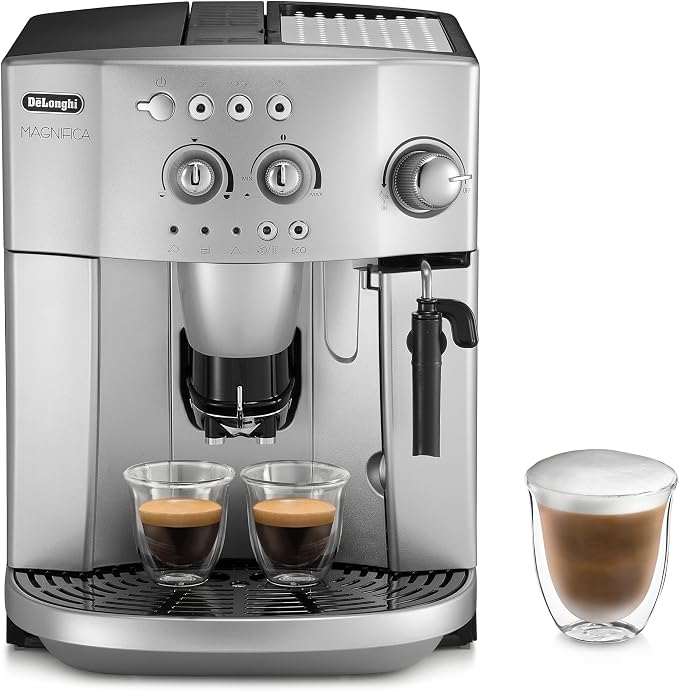
Features:
- 1 touch bean to cup (coffee only, not 1 touch milk drinks)
- Front loading easy access water tank: 1.2 litres
- 13 grind settings
- Large dishwasher safe drip tray
- Decent steam power
This has been among the best selling bean to cup machines on Amazon for several years, and as a result, there are a massive number of answered questions.
So this machine has a lot going for it in terms of the user being able to find out all of its quirks & pros and cons before deciding whether it’s the right bean to cup machine for them. By the way, by far the best answered question in my humble opinion, is this one:
Question: Does this device enable me to travel through space and time?
Answer: Hi, only if you possess a CONTINUUM TRANSFUNCTIONER, Cheers G
What is referred to here as a traditional frother is a pannarello wand / turbo steam wand, which most bean to cup coffee machines have.
These are basically a steam pipe with a sheath around it with air holes on the side, intended to foam milk without the learning curve associated with learning to steam milk with a pro steam wand.
See my video on steaming milk:
Pro steam wands that you’d find on commercial machines, and traditional espresso machines such as the Gaggia Classic Pro & Sage Bambino Plus, take some getting used to, although the Sage Bambino Plus also has an auto steaming function which is very impressive for a machine at this price!
Panarello wands like this one make it much easier to foam milk, but don’t give you any control over the foam, you just get whatever the machine wants to give you, which is usually dry, firm cappuccino foam.
The only Panarello I’ve used which is the exception to this is the De’Longhi Dedica EC685 which has a Panarello which is capable of steaming milk for latte art.
But with the ECAM 4200, and with most other bean to cup coffee machines with panarello wands, you can simply pull off the sheath and use the steam wand as a standard steam wand.
It takes a bit of practice to steam milk this way, and you may find you’re happy with the foam produced with the panarello wand, and if you are then great.
My Observations:

This is one of the lowest price bean to cup coffee machines available.
In fact, as far as I’m aware it’s the cheapest bean to cup espresso machine available in the UK right now, and actually, on paper at least, this machine has more going for it in terms of shot quality, than some of the much more expensive bean to cup machines.
While some of the more expensive machines have some great features, especially when it comes to convenience – the ESAM 4200 has as many grind settings as the more expensive De’Longhi machines, and double the number of grind settings of some much more expensive bean to cup machines.
While 7 grind settings with half-step increments doesn’t come close to what you’d expect to find on a stand alone espresso grinder, it does give you a bit more ability to dial in (find the grind that produces the best espresso from the beans you’re using).
I used the Esam 4200 as my main espresso machine for a week or so, in order to write my Delonghi Esam 4200 review. And I was very impressed with this bean to cup machine for the low cost, there’s really nothing offensive about this machine.
I can’t say “oh yeah it’s the cheapest bean to cup machine but here’s why”. Actually, it produces just as good shot quality and milk texture as many much more expensive machines.
It’s a fairly compact machine, and everything is well thought out. I love the front loading water tank.
Plenty of steam power and the steam pipe with the Panarello removed works perfectly well for producing decent milk texture, as you can see from a couple of photos of my latte art attempts above.
The only niggle I found with this machine is that it’s difficult to get back to the exact same settings.
The volume and strength dials are like volume knobs without any numbers for reference, which I found a bit of a pain, but not a deal breaker for such a bargain priced machine.
De’Longhi Magnifica S
The ECAM22 will create you the perfect espresso at the touch of a button as well as providing you the opportunity to make cafe style milk based drinks such as cappuccinos and lattes.
Beautifully crafted, this fantastic piece of engineering will allow you to start the day with the perfect coffee drink to suit you and will look stunning on your kitchen surface.
The machine has a silent integrated grinder with 13 settings so that you can tailor your coffee to your exact taste buds.
Espresso. The simple rotation of the dial lets you increase or decrease the coffee intensity. By pressing the corresponding buttons you can choose between short or long coffees.
Cappuccino. Cappuccino System device is ideal to produce a rich, creamy froth for great cappuccinos
Latte. Cappuccino System device is ideal to produce a rich, creamy froth for great lattes
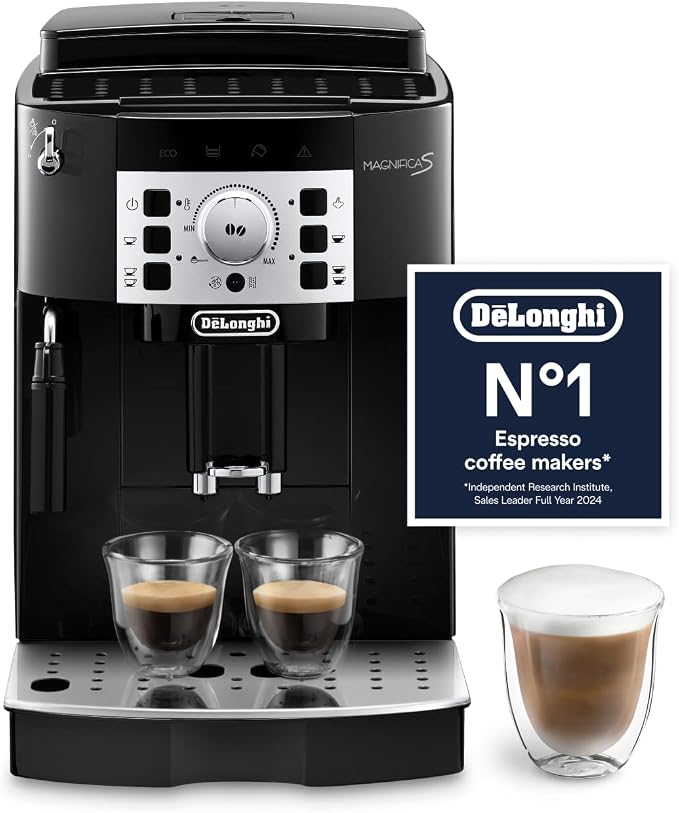
Features:
- Easy access front loading water tank: 1.8L
- Adjustable brew group height for different sized cups
- Steam wand doubles as hot water tap
- Fairly quiet grinding with 13 settings.
“Cappuccino system device” – is simply the Panarello wand. It does irritate me when manufacturers try to make up cooler sounding names for bog standard implements…
My Observations:
In my humble opinion, this is quite a lot of machine for the money.
It doesn’t cost a great deal more than the ESAM 4200, and it does have quite a few more features and refinements, which would make me tempted by this machine vs the slightly cheaper option, if I was on the market for a bean to cup machine.
It has a ridiculous number of Amazon reviews, which are very positive overall.
Obviously, there will always be negatives, but many of them appear to be rating the supplier rather than the machine.
For instance, there are multiple reviews referring to the machine having been sent to a UK address with an EU plug, and of course, this is a rating of the supplier, not the machine.
By the way, the reason this may happen is if you’ve (possibly unknowingly) purchased from a third party seller. Sometimes there is more than one supplier option available, and some may be cheaper than others.
The problem with simply choosing the cheapest supplier is that there are several firms that sell coffee machines in the UK from Italy and other countries.
Machines purchased from these firms are likely to come with an EU plug, and they may come with a return to Italy warranty too, so it’s worth doing some due diligence and just checking who you’re buying your machine from if it’s not a machine that is dispatched and sold by Amazon.
Just a quick update re the Ecam E22, readers have pointed out to me that there’s a new version of this, which is about the same price but has been released more recently. A few people have asked me if I can explain the difference.
Best Delonghi Machines
De’Longhi ECAM 21.117
DeLonghi really likes using numbers ;-), 21.110, 21.116, 21.117, just keep in mind that the first part of the number, in this case, ECAM 21, is the main model number, and the B or S is the colour (black or silver), and the final number is the specific variation, which is purely aesthetic differences as far as I’m able to tell.
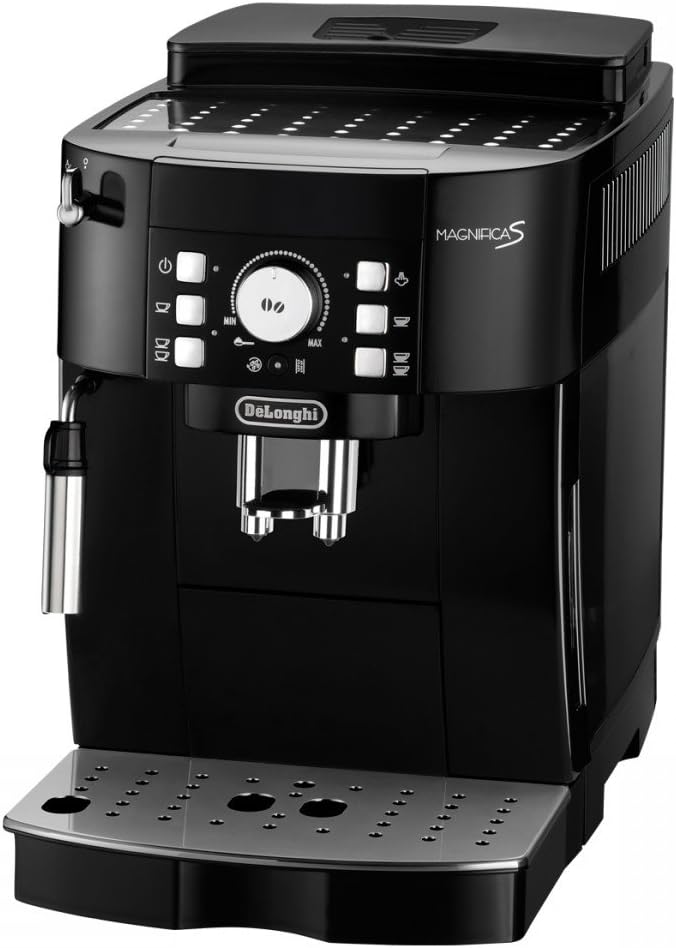
The 21.117 appears to differ from the first version of this model (21.110) just with the colour of the Panarello wand and other slight colour differences, I can’t find any meaningful differences in specs, and I think there are unlikely to be as they’ll usually release a new model just to change something simple like the steam wand.
This leads me to the other variation of the Magnifica S, the ECAM250 which as far as I can see, other than slight aesthetic differences only differs due to the steam wand.
De’Longhi Magnifica S Smart ECAM250
As I’ve just mentioned, they’ve given this a different model number, the Magnifica S Smart 250, but other than a few changes in the format of the controls, and very slight aesthetic differences, it appears (I’ve used both) to be the same machine except for the steam wand.
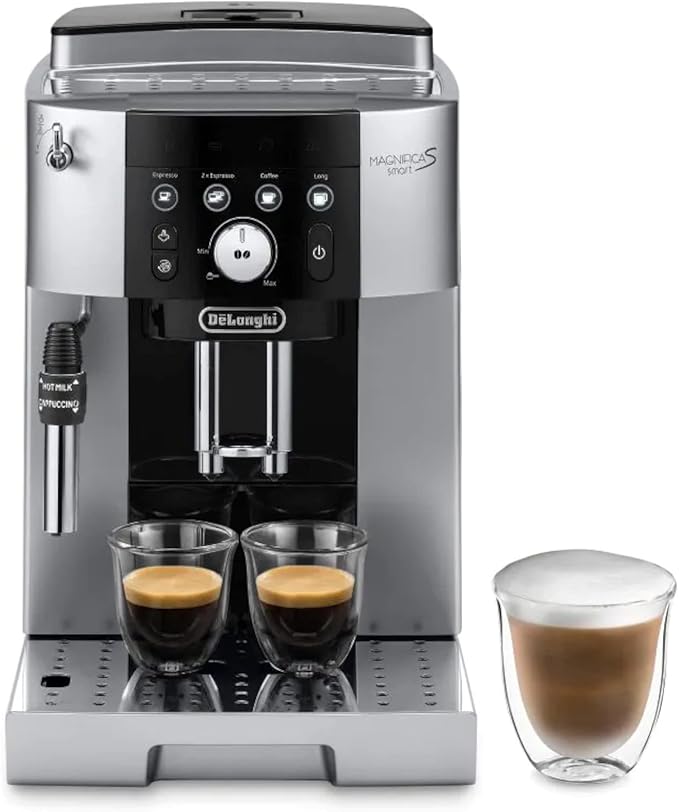
Personally, though, although a steam wand might not seem like a reason to go for a different model, I’d go for this one over the other similar versions of the machine, as long as the prices are similar, simply because I think this is the best Panarello steam wand that I’ve ever come across.
Panarello is the name for the sheath over the steam pipe which automatically injects air into the milk or milk alternative, and while I’m not a huge fan of these milk frothers, they are very, very simple to use, which is why so many domestic coffee machines feature them. DeLonghi came up with this particular version of Panarello steam wands with the DeLonghi Dedica EC685 traditional espresso machine (at least I think that’s the first machine this wand featured on, please correct me if I’m wrong), and I was really surprised the first time I used it.
It enables the same almost automatic frothing as with the standard Panarello, where the position of the tip of the wand relative to the surface has little impact, but it also has a really clever little feature that I think is very underrated, which is the ability to switch it from stretching to just heating.
Standard Panarello wands give you no control over how far you stretch the milk, which is why using wands like this tends to give you really stiff old school cappuccino foam. With this one, however, you’re able to decide when you’ve pulled enough air into the milk, and at that point, you can just change the setting so it’s only heating, and you’ll end up with microfoam.
This is a great feature, although you don’t have to use it. With both this type of Panarello and the standard one, you can slide it off and use the pipe underneath as a pro steam wand. There’s a knack to this, but once you’ve got it, you’ll be able to produce a great milk texture which is just as stretched, and just as hot as you prefer it.
Gaggia Brera
The Gaggia Brera is silver. The tank is 1.2 litres. It is 43 cm deep, 26 cm wide, and 33 cm high. It has ceramic grinders. A classic stainless steel pannarello dispenses steam, and hot water for tea. Reviews are 4.1 from 381 ratings.
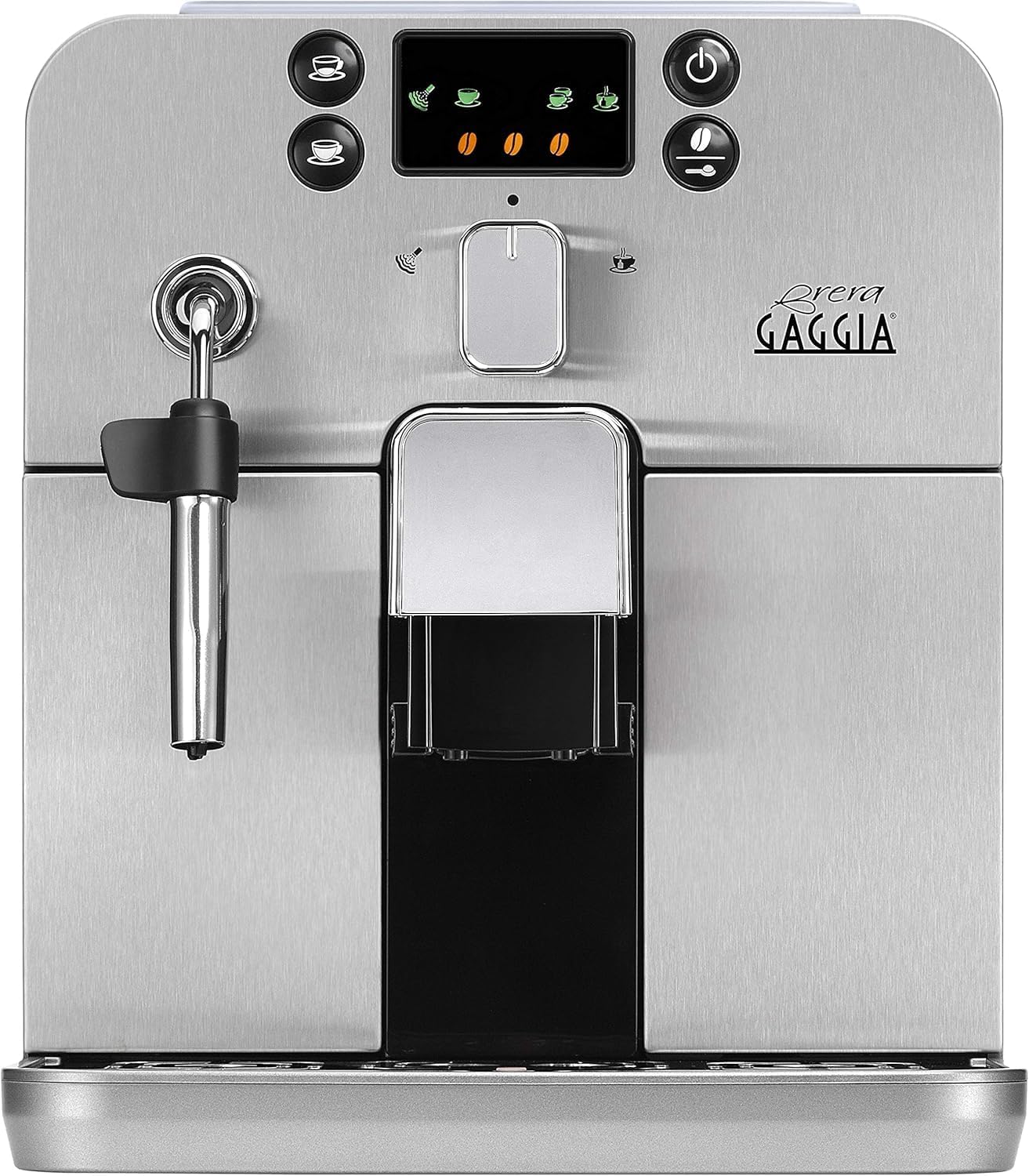
Features:
- Silver
- Tank 1.2 litres
- 43 cm deep, 26 cm wide, 33 cm high
- Ceramic grinders
- A classic stainless steel pannarello that dispenses steam, and hot water for tea
- 4.1 from 381 ratings
My Observations:

I think this is a brilliant little bean to cup coffee machine for a relatively low cost.
I used it for a week or so every day, as my home machine in order to write my Gaggia Brera Review, and I was very impressed.
It’s relatively quiet, it’s very easy to use, the steam power is nice & strong, and FAST, plus steam is ready very quickly. Removing the Panarello wand leaves a fairly long steam pipe which works quite well as a standard steam wand.
My only niggles are that I wish it had more grind settings (the two De’Longhi machines above are slightly cheaper, and have more grind settings), and I found the grind adjusting a bit stiff.
Although to be fair, the difference between 5 to 10 grind settings isn’t really going to make much of a difference, and I do realise that many bean to cup users won’t be touching the grind much anyway, so for most people, this probably won’t matter.
If you’re particularly fussy about dialing in (getting the grind spot on with each bean) you’re probably not going to be going for a bean to cup machine.
If shot quality is the most important thing to you, and you want to be able to perfectly dial in each time, even the likes of the Sage Oracle & Sage Oracle Touch which in my opinion are the very best bean to cup machines when it comes to shot quality, won’t get you as close to perfection as a traditional espresso machine in the hands of a competent home barista.
By the way, I usually find Amazon to be the best source of deals for coffee machines, but in this case – and with most Gaggia machines actually, Gaggia Direct, (the UK distributor for Gaggia) usually offers the best deal.
Also see my review on youtube:
Melitta Solo and Perfect Milk
The Melitta Caffeo Solo & Perfect Milk bean to cup coffee machine is the perfect combination of compact design and feature-packed technology that makes creating a great tasting cup of coffee quick and easy.
Easy Operation. The Melitta Caffeo Solo & Perfect Milk has an intuitive operating panel with a pared-down LED symbol display to keep things simple and straightforward.
There are two pre-programmed coffee settings plus special programmes for both lattes and tall coffees. Coffee strength and descaling and cleaning programmes can also be accessed by selecting the appropriate symbol.
Auto Cappuccinatore. Makes indulgent creamy coffees and light work of preparing hot water, warm milk, and light, frothy milk. You can set the desired amount manually using the dial.
Aroma Extraction System. To increase your coffee enjoyment the Melitta Caffeo Solo moistens the freshly ground coffee prior to brewing which releases the subtle flavours of the coffee. The ability to adjust the grind size and coffee strength in three stages will allow you to discover your perfect taste.
Height Adjustable Coffee Outlet. The height adjustable coffee outlet can easily accommodate latte macchiato glasses or mugs. The coffee outlet also allows you to make two cups at once using the double cup mode.
Cleaning and Maintenance. The Melitta Caffeo Solo & Perfect Milk features a removable brewing unit that can be rinsed clean under running water. It also allows the interior of the coffee machine to be cleaned with a damp cloth. The Melitta Caffeo bean to cup coffee machine will alert you if cleaning and descaling are required.
Melitta Companion App. This app features tips and tricks on how to get the best from your machine and make the perfect coffee plus illustrated step-by-step instructions for maintenance programmes and help with understanding the status of the coffee machine via the diagnostic tool.
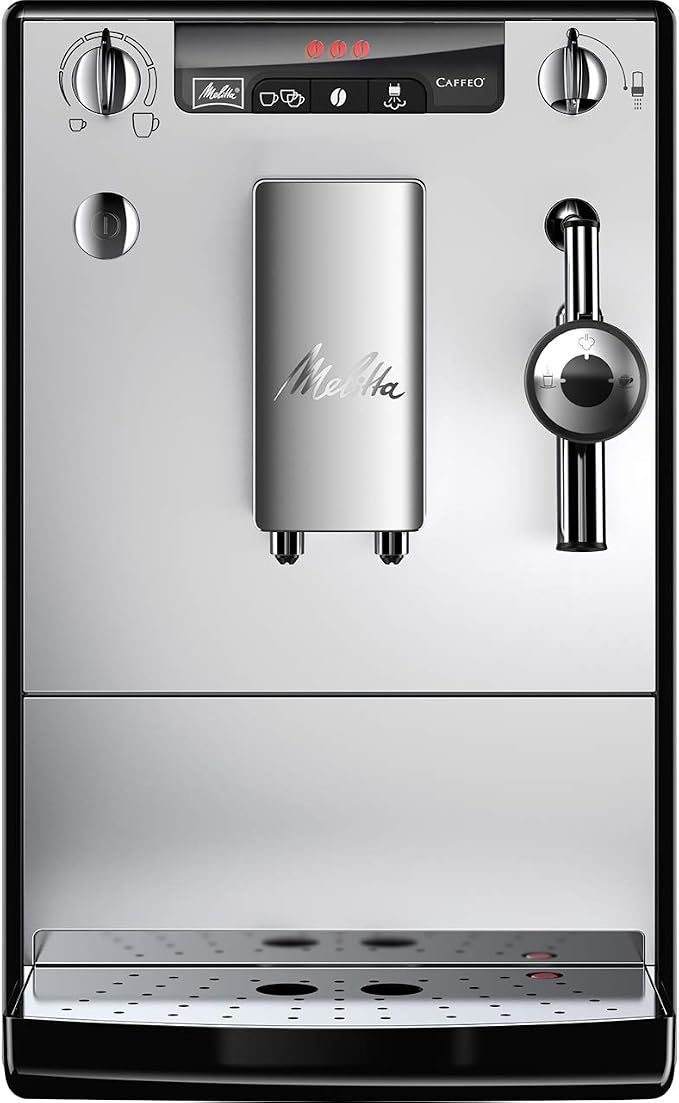
Check Price – Currys
Features:
- Auto pre-infusion (for enhanced shot quality).
- Compact & stylish
- Easy cleaning
- Cappuccinatore system for one touch milk
- Simple to use
My Observations:
This is an auto frothing bean to coffee machine, and this is one of the lowest-priced options.
For the price, which at the time of writing is cheaper than the De’Longhi Magnifica S Ecam E22 above, and only slightly more expensive than the ESAM 4200, this is an impressive looking machine.
The Solo uses a cappuccinatore for frothing the milk, vs a carafe system, which is one of the reasons (I think) for the lower cost of this machine, but actually, I think the cappuccinatore system has a lot going for it.
Instead of having to take out a milk carafe and put it in the fridge, or wash it out each time – you just put the cappuccinatore pipe into your milk bottle, the milk is then sucked up the pipe, frothed, and delivered into your cup.
Again, auto milk frothing whether delivered with this system or via a carafe isn’t going to give you much in terms of control of your milk texturing, but for a lot of people who value convenience over anything else, I think this machine has a lot going for it at this price.
It has a lot of Amazon reviews, which is always handy, as it means you can spend some time going through them and looking for recurring pros and cons.
By doing this, you can determine whether there may be some cons that would make a real difference to whether or not this would be the best bean to cup coffee machine for you.
In particular, I like to spend time going through the mid star ratings.
I find if you look at the one star reviews you’re usually looking at faults or people reviewing the supplier.
in the middle of the stars, around 3 & 4 are where you tend to find the interesting comments that may help you to determine if the pros and cons according to hundreds of users, suit your particular requirements.
If you spend some time reading the reviews, you’ll see that there have been a fair amount of faults, which have led to the replacement of parts or the entire machine.
The biggest complaints I’ve seen are about milk temperature and the quality of the milk foam.
It does appear to be a trending niggle, so if milk temperature and/or quality of the milk texture are particularly important to you, this may not be the best machine for you.
Having said that, I would never expect any one touch milk frothing machine to deliver amazing milk texture.
So if you’re someone who drinks a lot of milkies, and if you want great milk texture, I’d go for a manual milk frothing bean to cup coffee machine.
Take off the Panarello to use the steam pipe as a steam wand – or look at the likes of the Sage Oracle, or Sage Oracle Touch which have pro steam wands, and can create brilliant milk texture, but I’ll talk about these machines shortly.
Check Price – Currys
Gaggia Magenta Plus
The Gaggia Magenta Plus is black. It is 43.5 cm deep, 22.4 cm wide, and 35.7 cm high. It has ceramic grinders. The one-touch drinks named on its Amazon page are espresso, espresso lungo, and hot water. It has a stainless steel professional steam wand. Reviews are 3.7 from 65 ratings.
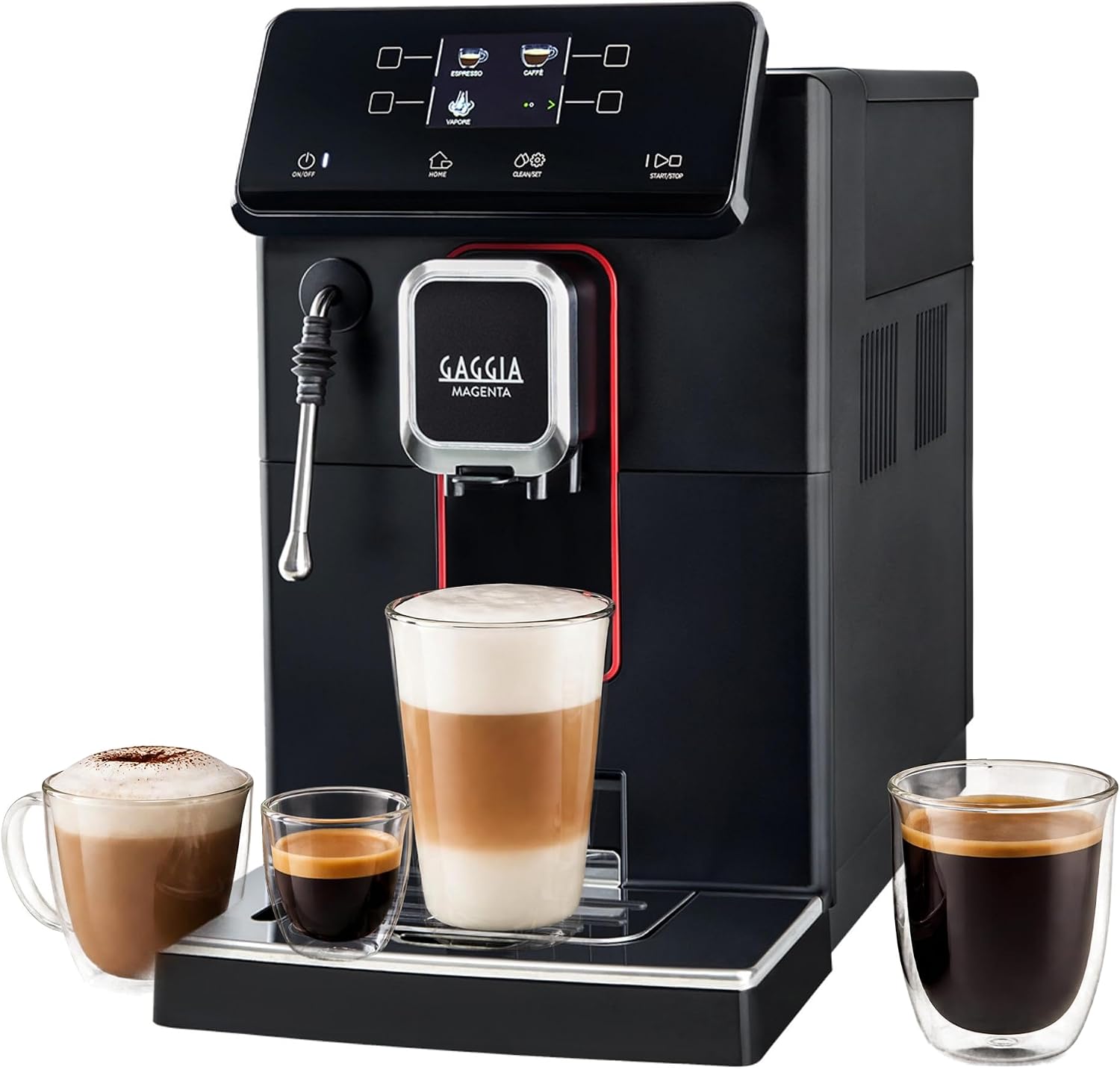
Features:
- Black
- 43.5 cm deep, 22.4 cm wide, and 35.7 cm high
- Ceramic grinders
- Stainless steel professional steam wand
- 3.7 from 65 ratings
My Observations:
If you mainly drink milkies, and if milk texture is important to you, this may just be your perfect bean to cup coffee machine.
As far as I’m aware, this is the first non-commercial bean to cup coffee machine available in the UK other than the £1500-£2000 Sage Oracle and Sage Oracle Touch, which features a steam wand.
Given the level of control you have over shots, including shot temperature, and given it comes with a steam wand, I think this is a very interesting bean to cup machine.
Gaggia Cadorna Prestige
The Gaggia Cadorna is anthracite. The tank is 1.5 litres. It is 44 cm deep, 26 cm wide, and 38 cm high. It has an integrated milk carafe, not a professional steam wand. It has four user profiles. Fourteen programmed drinks are ristretto, espresso, espresso lungo, coffee, americano, cappuccino, cappuccino XL, café au lait, café cortado, latte macchiato, latte macchiato XL, flat white, frothed milk, and hot water. Reviews are 3.8 from 183 ratings.
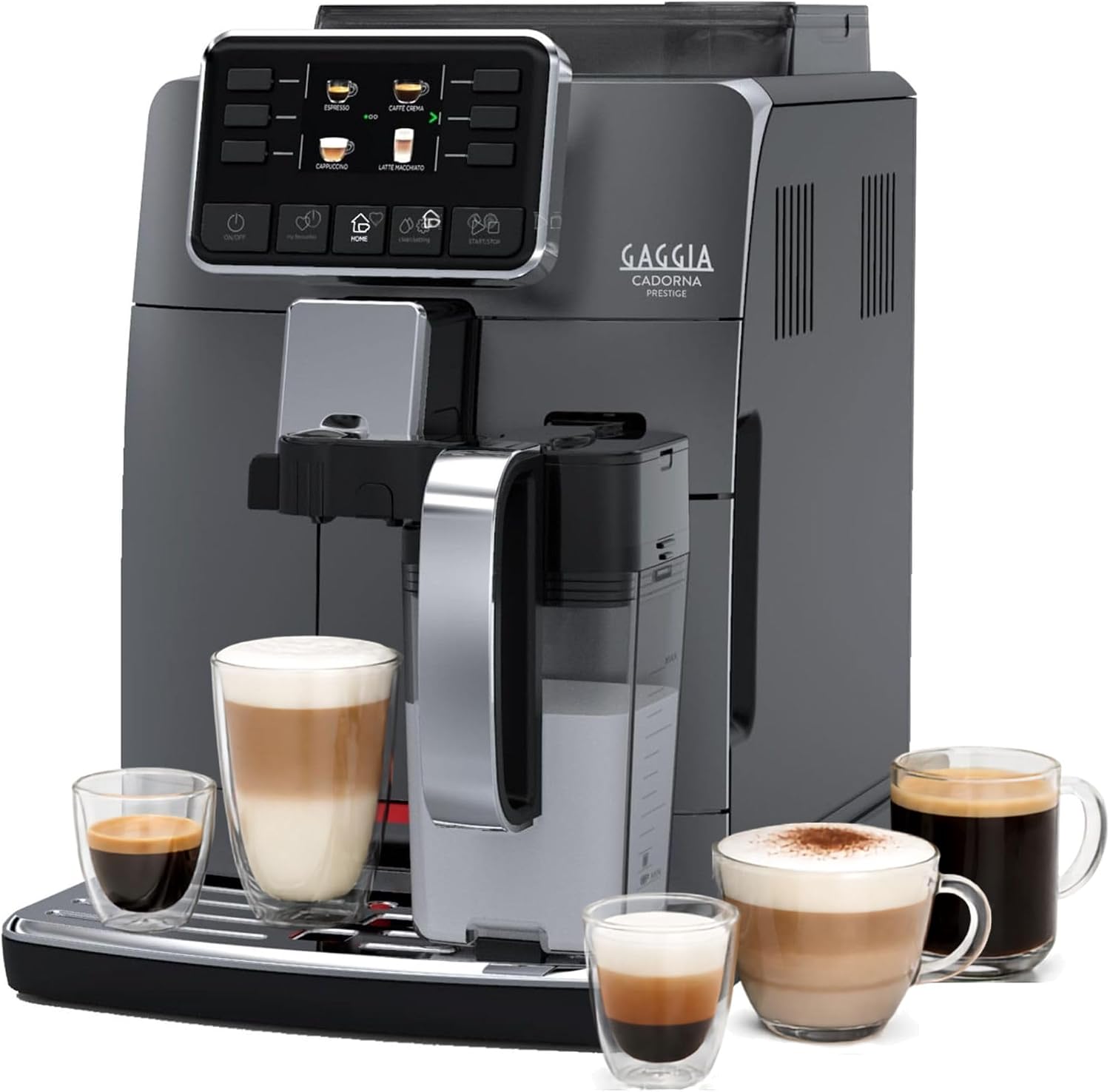
Features:
- Anthracite
- Tank 1.5 litres
- 44 cm deep, 26 cm wide, 38 cm high
- Integrated milk carafe, not a professional steam wand
- Four user profiles
- Fourteen programmed drinks: ristretto, espresso, espresso lungo, coffee, americano, cappuccino, cappuccino XL, café au lait, café cortado, latte macchiato, latte macchiato XL, flat white, frothed milk, and hot water
- 3.8 from 183 ratings
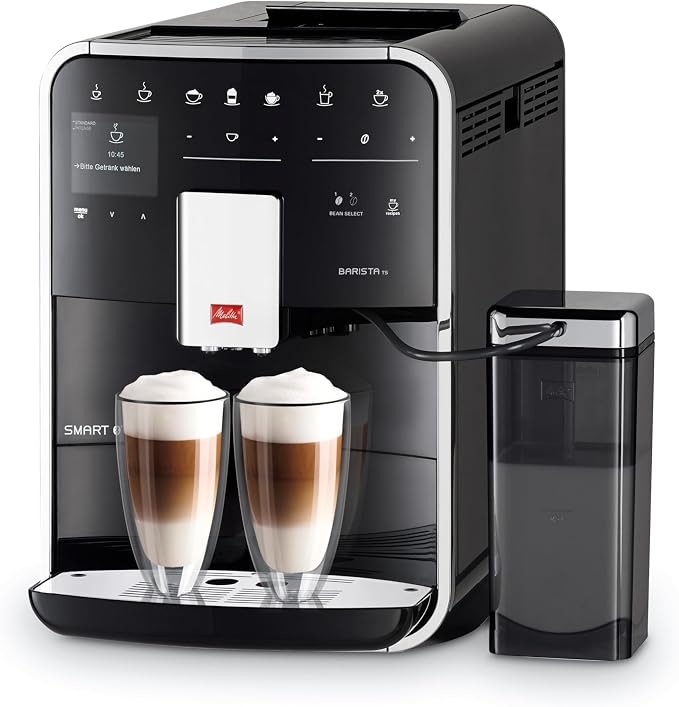
Melitta Barista TS Smart
- 21 different coffee presets which can be personalised via the Melitta connect App.
- Produces a huge range of coffee shop favourites including Café Crème, Espresso & Latte Macchiato.
- Patented tech including “best aroma system plus”, “Intense Aroma” and “Whisper Grinder”.
- Features two airtight coffee hoppers
- TFT touch screen display
- Automatic cleaning and descaling
- Engineered and manufactured in Germany
Check Price – Currys
Features:
- Cappuccinatore milk frother
- 21 pre-set coffees
- 1.8 Litre water tank
- Dual hoppers (kind of, but see my note below on this)
- Connected coffee machine – via Melitta Connect app.
My Observations:
This is an interesting machine from Melitta, and the general consensus from people who own the machine is that it’s great when it comes to the coffee side of things, people are generally impressed with the espresso and Americano this machine will produce, and the huge number of recipes, especially if using the app.
The 8 customizable user profiles with personal usernames instead of just a colour system, for example, is something that people are often very impressed by, and most people seem to be impressed with the app, except for those who aren’t… ;-).
Those who’re not impressed with the app, however, I’m not sure if it’s people with a particular phone or people with a particular version of the firmware, but there seems to be two schools of thought here, either the app connection is really easy and works well, or it’s awful and doesn’t work properly. From what I understand this is a firmware issue, and models from 2020 and onwards should be fine with Android or IOS but don’t quote me.
Talking about the app, I think it’s actually a really clever thing when it comes to the ability to create and edit so many different profiles and the various different coffee recipes you can select via the app, but there is one part of it that strikes me as a bit of a mistake, which is the fact that you can do all of this wonderful stuff remotely, including making coffee – but you have to physically walk up to the machine to turn it on.
I know, you’d have to walk up to it to put the cup on the drip tray, but the reason I’d want a smart coffee machine like this would be so I can order my first coffee of the day while I’m still arguing with my alarm clock. There’s no reason you couldn’t put a cup in place the night before, then wake up in the morning and order a coffee via your phone, other than the fact that there’s no way to turn the machine on from the app.
A quick note on the “two hoppers” feature. This machine essentially has a hopper which is split into two sections, and I do think that’s really clever, but it’s not perfect, especially not if you’re planning to use one of the hoppers for Decaf.
The first reason for this is simply that hoppers are the worst place to store coffee beans. I think you’re better off just chucking in roughly the amount of coffee beans you’re about to use, and keep your coffee in airtight containers, and if you’re doing this then the dual hopper system is neither here nor there.
I know, the marketing blurb does say that this is airtight, but I doubt that. I’d love to see some evidence that the hopper is airtight, as I don’t think that’s possible. You can put a rubber seal around the hopper lid, that will stop air from getting into the hopper once the lid is on, but then how is there no air available into the hopper via the burrs? The burrs aren’t touching, there’s a slight gap, and air is pretty small ;-), so I don’t think there’s a way to really make hoppers air tight.
How to store coffee beans correctly
Even if there was, by the way, this still doesn’t make hoppers a good place to store coffee beans, because what about the air you’re trapping in the hopper with the beans when you load beans in and then close the lid? With coffee storage solutions usually, you have some way of pushing out the trapped air.
The other issue with a split hopper like this is that many people will see it as a route for decaf, keeping decaf in one chamber and full caffeine beans in the other and while this works in theory, in practice it’s not a perfect solution due to exchanged retention.
Exchange retention is when some of the coffee you ground the last time you made a coffee stays in the grinder and ends up being used the next time you make a coffee. This isn’t huge, with domestic machines it tends to only be two or three grams, but the issue with dual hoppers and one grinder is you also have additional exchanged retention in the form of beans sitting on top of the burrs.
When the other chamber is selected, there will be beans sitting in the top of the burrs which will be ground first before the fresh beans are ground from the selected hopper chamber, so add this to the exchanged already ground coffee, and I would assume that unless you waste a coffee each time you switch chambers, you’re probably going to be drinking a fairly even mix of coffees from both hopper chambers, which isn’t great for the person who thinks they’re drinking decaf.
One of the things I like about Melitta is that as with Gaggia bean to cup machines, a double shot is a double shot, and this is one of the reasons you’ll see me featuring a few Melitta machines here, and Gaggia machines.
You can actually request a double shot, and get a double shot, meaning double the volume of espresso made from double the volume of coffee beans. OK, you can get the same on other machines by simply pressing the single espresso button once, waiting for the espresso to finish pulling, and then pressing it again, but it does make me feel better about an espresso machine when a double shot is simply made with double the weight of coffee beans.
Re the milk, this is handled with a cap in cup frother, also known as a cappuccinatore. I generally prefer this type of frother to the carafe systems where you have to fill a carafe with milk and slot it onto the machine. They tend to be a bit more laborious when it comes to cleaning, and cappuccinatore milk frothers are so simple.
There’s just a milk pipe which you can put into the milk container which sits next to the machine, or just slap it in your milk bottle, the milk is sucked into the machine, frothed, and delivered into your cup.
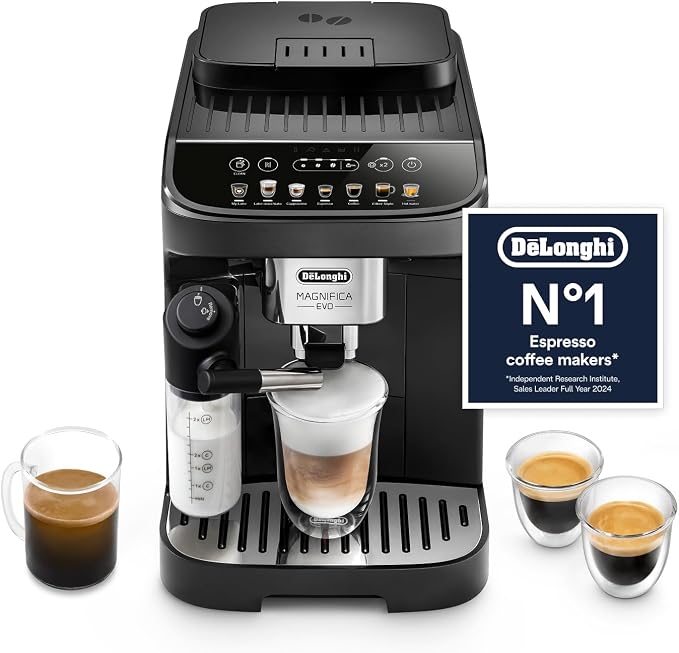
De’Longhi Magnifica Evo
Freshly Made Coffee
The Magnifica Evo freshly grinds your coffee beans just as your coffee is being brewed, to ensure the freshest espresso and tastiest espresso-based beverages.
Colour Display
Attractive colour control panel with easy to use soft-touch selections and coloured icons for a range of different one-touch coffee recipes.
LatteCrema System
The new LatteCreama system, exclusive to DeLonghi, enables one-touch milk-based coffees with long lasting rich milk foam at the perfect temperature and texture.
7 One-touch Recipes
All of your cafe favourites at a single touch of a button.
Features:
- 7 one-touch coffees (with this version)
- 1.8 Litre water tank
- Carafe milk frother (with this version)
- Colour screen display
My Observations:
At the time of writing at least, this is one of the very latest bean to cup coffee machines from DeLonghi. It’s entry to mid-range in terms of price, and it’s quite an impressive little machine, on paper at least.
The reason I say “with this version” for a few of the features, is that there are a few different versions of this machine, the cheaper Evo 292.33 version for example has a steam wand instead of the one touch carafe, and that one doesn’t have the one touch milk drinks.
It’s a new machine so early days regarding reviews, but the only real gripes I’m hearing so far is that the instruction manual isn’t great and you’re best jumping on YouTube for video setup guides. Also, a few people have mentioned that the milk is a bit on the cool side.
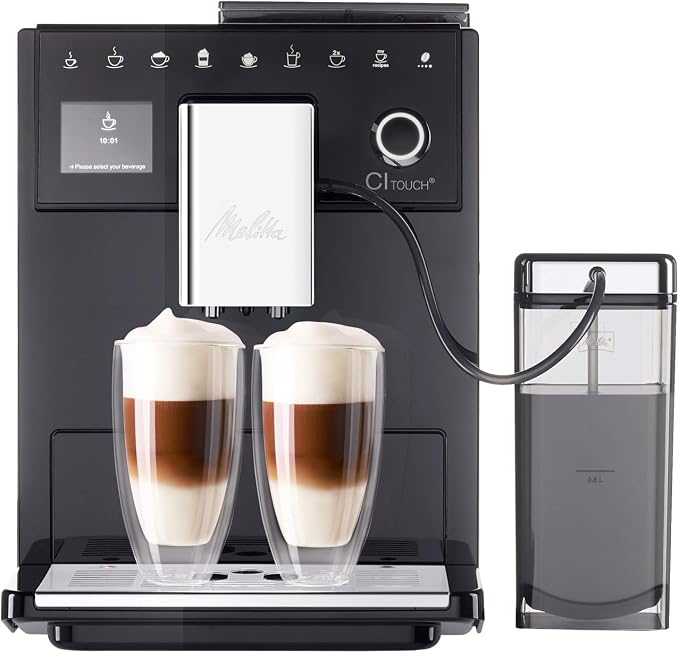
Melitta CI Touch
Be Your Own Barista with the Award-Winning Caffeo CI Touch
Innovative Bean-to-Cup Coffee Maker Accommodates Individual Preference
With its double-sealed 2-chamber Bean Select system for flavour variation, the user-friendly Caffeo CI One-Touch moves swiftly in its mission to optimally extract both flavour and aroma, as beans are systematically pre-wetted to enliven your senses.
This fully-automatic bean-to-cup coffee machine offers 3 brew temperatures, 4 strength levels, and a double-cup option for simultaneous arrival of two drinks.
Its “My Coffee” memory-feature stores up to four personal preferences, and the option to rotate between Espresso, Cappuccino, and Latte Macchiato (among others) offers a feeling of an Italian cafe within the comfort of your own home or office.
With its smooth surface, refined design structure, and push-button cleaning components, it is well within your reach to maintain the pristine integrity of this innovative and long-lasting Melitta coffee maker.
Features:
- Auto or manual milk-steaming – your choice
- One touch dial for 10 different coffees
- Colour TFT display
- 1.8L water tank
- 2 hopper chambers
- Adjustable brew group for different cup sizes.
- Automatic cleaning and descaling
- Compatible with Melitta Pro water filter cartridges
- Removable extraction chamber for easy cleaning
- Brew temperature control
My Observations:
This is a one-touch, auto milk frothing bean to cup machine, and it appears to have a lot going for it in terms of features for the price.
It has a fair number of Amazon reviews considering it’s only been available for a couple of years (at the time of writing), and there are lots of positives.
The dual-chamber hopper – is about as much use as a chocolate fireguard, in my humble opinion. If you’re thinking of buying this machine because of this feature, I’d recommend against it.
In theory, it seems a clever idea to have for instance an espresso blend in one chamber and a lighter roasted bean in the other chamber, or full caffeine in one and decaf in the other.
BUT – there’s only one grinder, being fed by two hoppers – well, one hopper split in half.
So when you switch from one hopper to the other, what about the grinds retention, and not only that, what about the beans retention, meaning the beans that are sitting on top of the burrs from the other chamber when you switch chambers?
Basically, you’re going to end up drinking a mix of the coffee from both chambers – unless you make coffee and chuck it away after switching hopper chambers, and how much you’d need to chuck away would depend on the grinding retention and how many beans are sitting on top of the burrs, it could be two or even three coffees that you’d need to make and pour away.
So as far as I’m concerned, dual hoppers are completely pointless unless they’re feeding dual grinders, as is the case with the DeLonghi Maestosa, and the Siemens EQ.9 plus connect s700, which both have two separate grinders.
Check Price – Currys
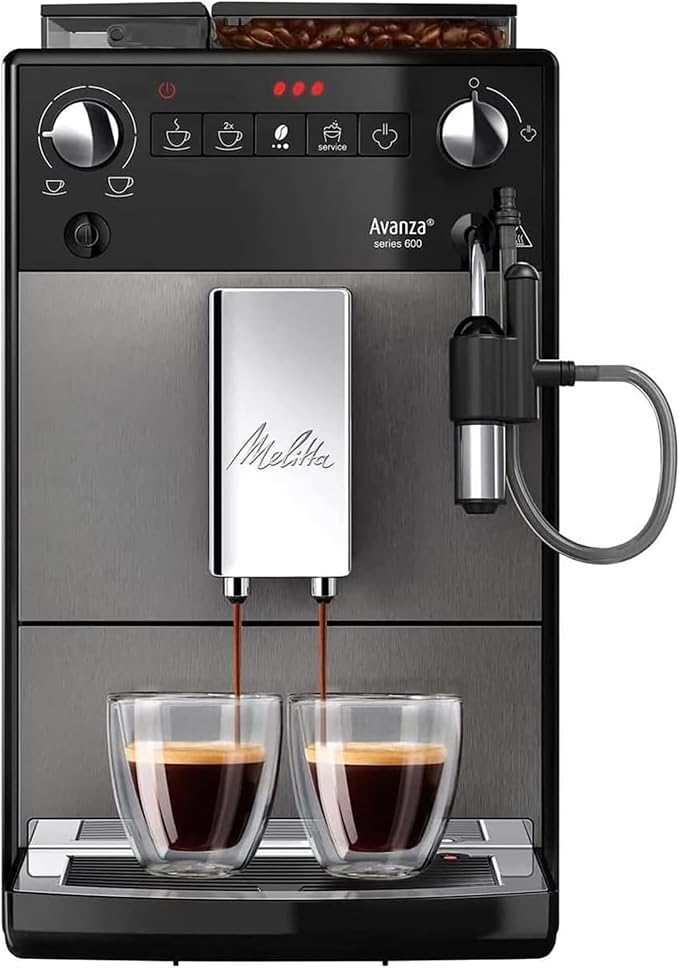
Melitta Avanza
Among the most compact bean to cup coffee machines on the market, the Avanza fires on all cylinders and punches way above its weight class and price class, offering effortless one touch espresso & café crème, plus cappuccino, latte & more via the simple to use and simple to clean cappuccinatore frother.
Check Price – Currys
Features:
- Cappuccinatore milk frother
- Very slim at under 20cm wide
- 1.5L water tank
- Pre-infusion
- Simple dose control
- 5 grind settings
- Removable brewing unit
- Auto cleaning and descaling
- Espresso & Café Crème from one touch
- Volume settings with markings
- 3 adjustable brew settings
My Observations:
This is a neat looking and relatively new bean to cup coffee machine from Melitta, and it seems to be quite a nice little compact machine at the low to mid price range. It’s a cappacinatore machine, which basically means that it has the milk frother that would usually be inside a milk carafe, but there’s no milk carafe, so you just chuck the pipe into your milk bottle, and the frother froths the milk (because that’s mainly what frothers tend to so) and delivers it into your cup.
It has three-dose settings with simple bean selections, as with the Gaggia bean to cup machines, and the volume setting is on a dial similar to the DeLonghi machines, but there are some references in the form of markings around the dial to refer to, although there are no numbers (that could be remedied, with stickers, or Tipp-ex – stickers would probably look neater…).
This machine doesn’t have a bypass chute, so just keep in mind that you can’t use pre-ground coffee with it. There are five grinding settings, but the Manufacturer has actually answered a question about the grind settings in the Amazon questions and answers, which is quite interesting.
Someone has asked about the grinding settings, and Melitta have answered appearing to recommend not adjusting the setting at all from the factory pre-set until at least a thousand coffees have been made. This seems odd, I’m sure if they’ve misunderstood the question and are talking about some form of internal burr adjustment, or whether they’re saying that the grind adjustment is only there to be made finer over the years as the burrs wear.
Just keep in mind that this isn’t a fully automatic bean to cup coffee machine as the blurb states, not when it comes to how we tend to classify fully automatic in the UK, this may be lost in translation a bit from one country to another, for example, bean to cup machines are usually referred to as fully auto or super auto machines in the states, whereas here if we refer to a bean to cup machine as fully auto this would usually be an automatic on the milk side as well as where espresso is concerned.
There are a few gripes in the reviews stating that they thought they were buying a fully automatic machine, which would produce one touch milkies for them, but it’s not that kind of machine – it will produce the coffee for you (espresso and Café Crème) on a one touch basis, but the milk is a manual affair, although all you have to do is stick the pipe into your milk bottle and press the steam button, so there’s not a massive amount of work required.
De’Longhi Eletta Cappuccino
Enhance your everyday with Eletta Cappuccino, De’Longhi’s innovative automatic coffee maker. Savour a velvety smooth caffe latte or prepare two espresso cups at once and enjoy your coffee with a friend.
Combining cutting-edge coffee technology with trademark Italian style, this sleek white and stainless steel design fits seamlessly into any modern kitchen.
- Coffee and milk based beverages at the touch of a button
- Brew 2 espresso cups at the same time
- Creamy, dense, long-lasting milk foam at the perfect temperature with the automatic LatteCrema System. Auto clean milk carafe
- Customise aroma and quantity
- White finish with stainless steel detail and button control panel
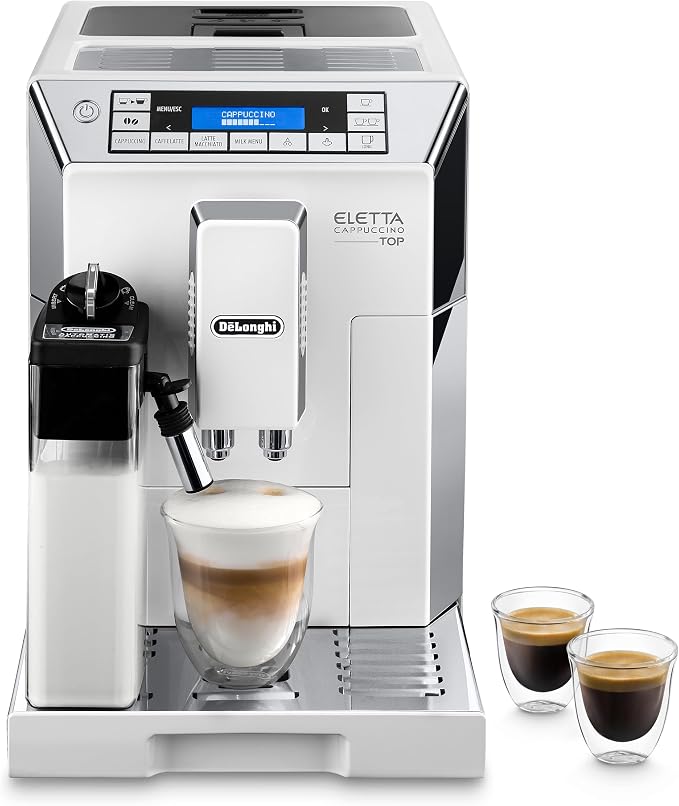
Features:
- 9 one-touch buttons including flat white
- Adjustable milk froth
- Complete control over each coffee including coffee temperature & strength
- Adjustable brew group height for different sized cups
- Intuitive touch control panel
- 2 litre water tank
Re the “enjoy your coffee with a friend” bit, that’s easier said than done at the moment, eh? Unless you happen to live with your friend of course.
My Observations:
This is another very successful bean to cup coffee machine from De’Longhi, as you’ll notice if you look at the reviews – it has racked up a tonne of reviews, and the overall rating is very impressive.
Although it’s largely positive, there are a few complaints that the flat white this machine produces isn’t a flat white, and this is no surprise to me. It’s a tall order to get a properly made flat white at a coffee shop, let alone from a machine.
If flat whites are your milky of choice, as they are mine, then I’d avoid an auto milk frothing machine, steam your own milk.
Yeah, there’s a learning curve, but once you get it you’ll be able to make better flat whites than you’d get from any machine, and from most coffee shops too.
Sage Barista Touch
Create third wave speciality coffee at home with ease.
Barista-quality performance with new intuitive touch screen display with pre-programmed café drinks menu and automatic milk texturing. All within a compact footprint. A built-in grinder delivers the right amount of ground coffee on demand and with a 3 second heat up time, you go from bean to cup, faster than ever before.
Clever. Automatic. Customise.
Intuitive touch screen display simplifies how to make your favourite café coffee in 3 easy steps – Grind, Brew and Milk.
You can easily adjust the coffee strength, milk texture and temperature to suit your taste. Then save it with your own unique name. Create and save up to 6 personalized coffees.
Automatic Micro-Foam Milk Texturing.
Auto steam wand, allows you to adjust the milk temperature and texture to suit your taste. Delivering barista quality micro-foam that enhances the flavour of the coffee and is essential for creating latté art.
Faster Heat up Time
Innovative ThermoJet™ heating system achieves the optimum extraction temperature in 3 seconds. Ready to make your best coffee without the wait.
Precise Espresso Extraction
Digital Temperature Control (PID) delivers water at precisely the right temperature, ensuring optimal espresso extraction.
Integrated Coffee Grinder
With a single touch, the integrated conical burr grinder with dose control delivers the right amount of coffee on demand, for maximum flavour.
Hands Free Operation
Innovative grinding cradle allows any at-home Barista to grind directly into the espresso portafilter.
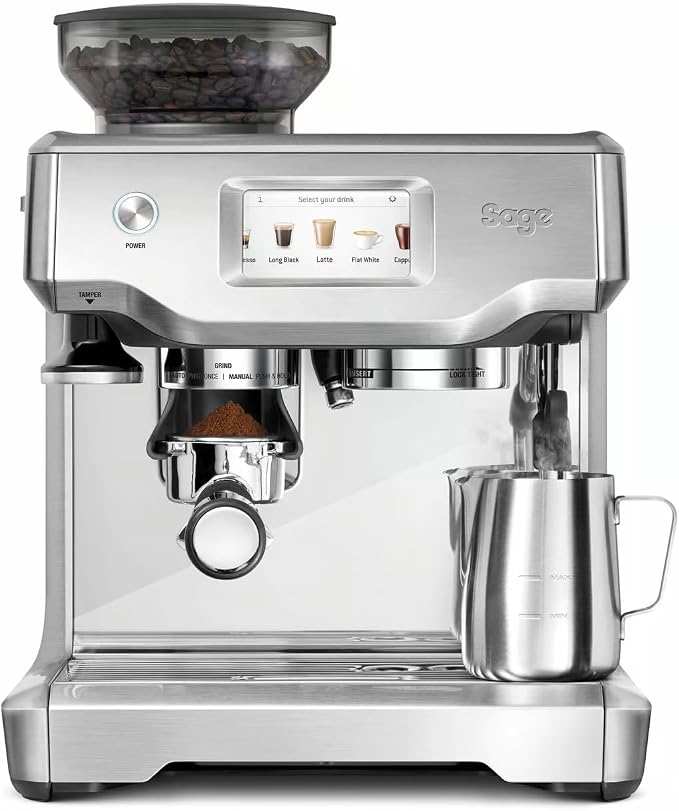
This isn’t a bean to cup machine, strictly speaking, but it’s very close – and it may be the absolute perfect machine for some people reading this post, which is why I decided to include it.
By far my favourite bean to cup machines are the Sage Oracle and Sage Oracle Touch, which I’ll discuss a bit later, and the Barista Touch is very close to these two machines. It lacks very little actually in the way of bean to cup type features, and it’s about a grand cheaper than the Oracle touch, which is why I think I have to include the Barista touch.
Features:
- Simple touch screen operation
- 5 pre-programmed coffees
- 6 personalised coffees
- 29 grinder settings
- Automatic or manual milk steaming – your choice (automatic produces near-perfect milk texture!)
- Stainless steel construction
- 3 second heat up time
If you tend to take marketing blurb with a pinch of salt, I’m with you!
Some of the blurb I read really annoys me ;-), especially when people try to invent new exciting sounding terms for really standard features.
Most of the marketing blurb you’ll read on Sage products, though, is bang on.
This is something I’ve learned over the years from becoming a user of Sage machines.
OK, the “hands free operation” is a bit of a stretch, it just has a portafilter cradle, that’s really nothing ground breaking ;-), but everything else is spot on.
This latest wave of machines from Sage (Breville Worldwide, but sold in the UK under the brand Sage Appliances as of course there’s another Breville brand here, the name was sold in the 80s I believe) really do heat up in 3 seconds.
This was the main thing I was skeptical about when they first unveiled this new thermojet system. I have the Bambino Plus, which has the same system, and it really is ready that quickly.
The Automatic milk texturing is something else I was initially skeptical of, but that’s right too, as this is another feature the Bambino plus shares. You can choose from three temperature settings and three foam settings, and it really does make proper microfoam that you can pour latte art with.
You can steam manually if you like, as I do, and with practice, you will be able to produce just slightly better microfoam than is possible on auto, but still, the quality of the milk these machines are capable of on auto, I believe to be far, far superior to any of the auto milk foaming bean to cup coffee machines.
My Observations:
As I mentioned earlier, strictly speaking, the Barista Touch isn’t a bean to cup machine, but there’s only really one small bean to cup element missing, which is tamping.
The Oracle range that I keep harping on about, is a full bean to cup with one distinct difference, which is that they require the user to simply move the coffee around, which does two things.
Firstly, it deals with a problem that bean to cup machine designers have to get around, which is automating dumping the used coffee grounds into the dump box inside the machine and ensuring that the user can’t allow it to overfill.
Secondly, it gives bean to cup users a more authentic home barista experience.
While Oracle users are only manually carrying out one small part of the process, moving the portafilter from the grind position to the group head & then knocking out the puck of coffee from the portafilter.
This handling of the portafilter is the main thing most people associate with the Barista experience.
So the Oracle machines allow home espresso machine users to feel like home baristas, and to experience a similar level of quality in the cup that they’d experience, but without having gone through the home barista learning curve.
The only extra step a barista touch user has to carry out is tamping (using the tamper to put pressure on the ground coffee in the basket), and actually – this is another key part of the home barista thing.
So for some people, the barista touch is perfect, providing just a bit more of the authentic home barista experience without requiring much in the way of developing skills.
Yes, there’s some skill involved in tamping, but it’s not quite at the same level as learning to pull decent shots with a traditional espresso machine without any automation.
Also, the Sage machines come with the razor tool, which ensures a level surface & the right space between the top of the puck of coffee and the shower screen in the group head.
This does make it harder to mess up the tamp, as the main mistake people make when tamping is either not getting the correct dose into the basket, or not tamping level.
By the way, if you think you might enjoy the home barista thing to the point that you may want to actually develop the skills rather than rely on automation, the Sage Barista Express is almost half the price of the Barista Touch.
The Barista Pro is the newer version of the Barista Express, and has the same newer thermojet system. There’s also the Sage Dual Boiler, which is the same dual boiler machine as the Oracle & Oracle touch (means you can pull shots and steam milk at the same time) but without the bean to cup stuff.
Check Price – Sage Appliances
Check Price – Currys
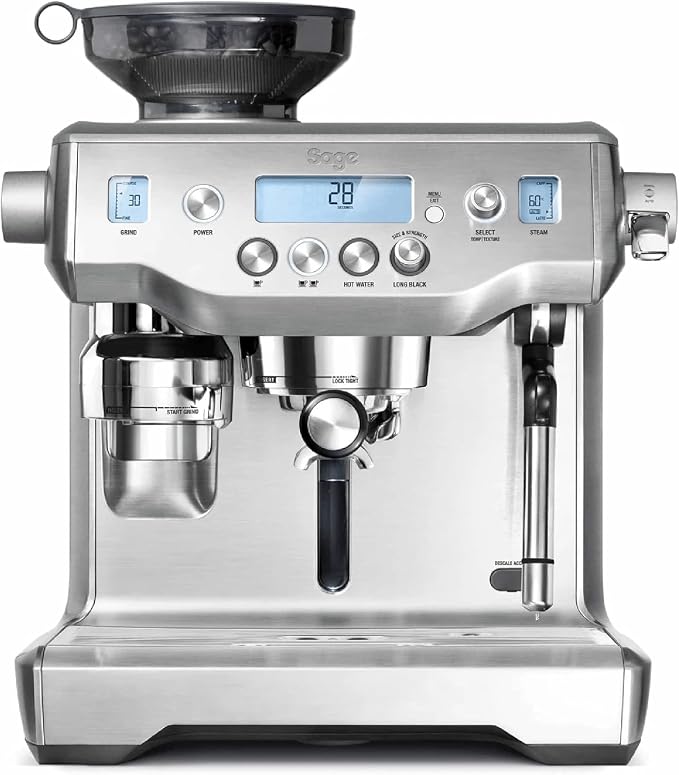
Sage Oracle
As I’ve mentioned, this is one of my two favourite true bean to cup coffee machines.
Check Price – Sage Appliances
Check Price – Currys
I say “true” because if we were to take that out of the equation and include the Barista Touch I’ve just mentioned, I’d say my three favourites. I think this is a perfect fit for a lot of people looking for a bean to cup coffee machine.
The Oracle was the first coffee machine I ever reviewed. Sage sent me one on loan for a week or so in order to review it, by this point (almost 5 years ago, at the time of writing) I was mainly using manual brewers, and hadn’t yet begun my home barista journey.
I was very impressed with the machine, but it was only once I started the home barista learning curve that I fully appreciated the quality of the coffee and milk texture this machine was able to produce straight out of the box.
Until you’ve tried using a manual espresso machine and you come to realise just how much skill is actually involved, you might not fully appreciate just how much work must have gone into producing a machine that delivers results like this straight out of the box.
Features:
- Dual Boiler – pull shots and steam milk at the same time for faster coffees
- 2.5L water tank
- Proper low pressure pre-infusion – reduced chance of channeling = increased shot quality
- PID control – ensures stable brew temp = increased shot quality
- Auto on and off – set it to be ready to use when you wake up needing coffee
- Full sized 58mm portafilter – comes in handy when it comes to buying third party accessories, naked portafilters, tampers, baskets, etc.
- Big, strong double shots – made from 22 grams of coffee
- Auto Dosing & Auto Tamping for as close to perfect extraction every time
- Auto milk steaming with control over milk temp and texture
- Auto steam wand purging
- One touch Americano / long black – water delivered via a separate water tap, not dispensed through the coffee grounds.
My Observations:
Sage (or Breville in Australia who create the machines, we know them as Sage Appliances here) are a very clever bunch of people.
It’s apparent from their products that they take a step back when creating machines & look at things from a fresh perspective, rather than just looking at what others have done.
They clearly did a lot of stepping back when creating their answer to the bean to cup question, as it’s so different to any other bean to cup coffee machine that came before it.
“Normal” Bean to cup machines, for want of a better word, offer the untrained coffee lover espresso and espresso-based drinks at home, at the touch of a button, straight out of the box without the skill development required to get semi decent results from a traditional espresso machine.
They do this, but it comes at a sacrifice to cup quality.
There’s no doubt at all that a traditional espresso machine in the hands of a skilled home barista will deliver espresso and espresso-based coffees that even the best bean to cup machine wouldn’t be able to come close to delivering.
But for years, bean to cup coffee machines have been great-selling machines because many coffee lovers place such a value on convenience.
They’re busy, they just want to press a button and get their favourite coffee, and they don’t have the time or inclination to embark upon a hobby (and becoming a home barista really is a hobby even though many people don’t quite get that when they begin).
What the Sage Oracle did, though, was to address a particular niche market, which is busy people who want the convenience of bean to cup, but without any sacrifice in cup quality.
I’m not talking here about superficial things, bells & whistles, I’m talking about fundamentals.
For example, the Oracle has 45 grind settings. This gives the Oracle a huge advantage over any other bean to cup machine I’m aware of.
All of the other bean to cup machines featuring in this post (and all of the machines I’m aware of) except the sage machines have between 5-13 grind settings.
Being able to more finely adjust the grind size makes a huge impact on shot quality. So this is a huge plus for the Oracle even before we take any of the other features into account.
But then we have things like pre-infusion, PID (digital temperature control), 21 gram double dose, Americano being made with hot water via a dedicated water spout so it’s not basically a long over extracted shot, dual boiler, auto milk texturing.
While I don’t think you’re ever going to get a bean to cup machine up to 100% of the potential cup quality of a decent home barista set up and a decent home barista, these features I believe get the Sage Oracle about as close as anyone is likely to get.
Also, keep in mind that I said a decent home barista setup and a decent home barista. I would expect the Oracle to be able to deliver better quality coffees straight out of the box in the hands of a complete beginner than a novice with a great home barista setup. You should have tasted some of the coffees I made early on my home barista journey… 😉
Check Price – Sage Appliances
Check Price – Currys
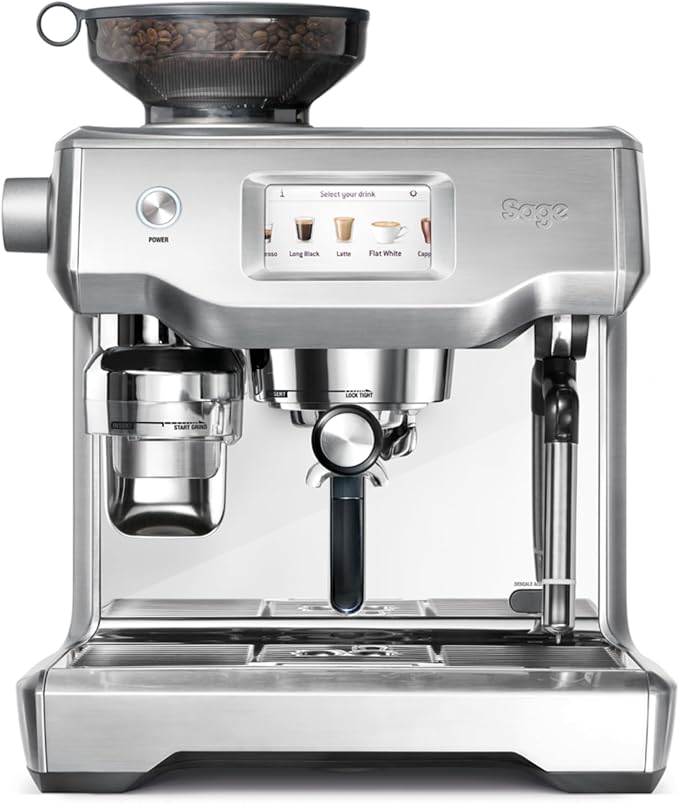
Sage Oracle Touch
Automated, touch screen operation simplifies how to make your favourite cafe coffee in three easy steps – grind, brew and milk.
You can easily adjust the coffee strength, milk texture or temperature to suit your taste. Then save it with your own unique name. Create and save up to 8 personalized coffees.
Swipe. Select. Enjoy. With automation at every stage, simply swipe and select for espresso, long black, latte, flat white or cappuccino and enjoy café quality coffee at home.

Check Price – Amazon UK
Check Price – Sage Appliances
Check Price – Currys
I’m not going to go into as much detail here simply because this is a newer, touch screen version of the Oracle, and many of the features are the same.
Features (which differ from the Oracle):
- Simple touch screen operation
- 5 pre-programmed coffees
- 8 personalised coffees
Also watch:
My Observations:
For me, the newer Oracle Touch is aimed deeper into the bean to cup market than the Oracle is.
In other words, while The Oracle perhaps grabs the attention of the folk who know that they want better quality than bean to cup machines are likely to deliver, I think the Oracle Touch is aimed more at the folk who swear by bean to cup, and are looking for the best when it comes to simplicity and convenience.
Let’s imagine you’ve been a bean to cup machine user for years, and your eyes are drawn to the Oracle Touch because of the intelligent looking user controls and personalisation.
14 Best Bean to Cup Coffee Machines – Conclusion
So this is the up to date list of what I believe to be the current 14 best bean to cup espresso machines in the UK.
I’ve recently completely updated this list as a lot had changed in the world of coffee machines since I first wrote this post, and I will continue to keep a close eye on things and update it again as things change.
Frequently Asked Questions
What is the difference between bean to cup and traditional espresso machines?
Bean to cup machines produce espresso at the touch of a button, while traditional espresso machines require developing home barista skills to operate. Traditional setups necessitate purchasing both an espresso machine and a separate grinder, along with learning techniques for grinding, tamping, and extraction. Bean to cup machines automate these processes, making them suitable for those seeking convenience rather than the manual control of traditional espresso preparation.
Do bean to cup machines make real espresso?
Bean to cup espresso machines produce authentic espresso meeting the SCA-standard 9-bar pressure definition. These machines are classified as fully automatic or super automatic espresso machines and represent one of two primary methods for making genuine espresso at home. The alternative method involves traditional semi-automatic espresso machines paired with separate grinders, which require manual barista skills to achieve comparable results.
Are bean to cup coffee machines suitable for office use?
A bean to cup machine suits a home, including a home office where only a few coffees are made each day. The machines in this guide are home machines. An office where several people each want a few coffees, and where drinks are also made for visitors, is a different job. A queue of people on a short break will be slow on a home machine, and that workload can wear a home machine out sooner. That case points toward a commercial machine.
What type of coffee do bean to cup machines make?
Bean to cup machines specifically produce espresso and espresso-based coffees using the SCA-standard 9-bar pressure definition. These machines are distinct from bean to cup filter coffee machines, which operate using non-pressurized brewing methods. The espresso-focused bean to cup systems grind whole beans immediately before extraction and can typically prepare various espresso-based beverages including drinks requiring milk frothing capabilities.
Why are bean to cup machines called fully automatic?
Bean to cup machines are referred to as fully automatic or super automatic espresso machines because they automate the entire brewing process from grinding to extraction. These systems eliminate the need for home barista skills that traditional espresso machines require, handling grinding, dosing, tamping, and brewing automatically. The terminology distinguishes them from semi-automatic traditional espresso machines, which require manual operation and technique development.
What are the different types of bean to cup coffee machine?
There are two main kinds. A bean to cup machine with a steam wand grinds and brews the coffee, and you steam and pour the milk yourself. A one-touch machine, also called a cappuccino maker, makes the milk drink from one button as well.
Which type of bean to cup coffee machine do I need?
A steam-wand machine such as the Gaggia Brera, the De’Longhi Magnifica, or the Gaggia Anima usually costs less and lets you set the milk temperature and texture yourself. Most one-touch machines make thick foam with large bubbles. That suits an old-style cappuccino, and it does not suit a flat white, which needs fine microfoam. The Sage Oracle and Oracle Touch are the exception here: they still use a wand, but the machine textures the milk in the jug, and that foam can be poured for latte art. They are not the cheap option. Most steam wands on these machines are covered by a pannarello, also called a turbo frother. The cover pulls in air and makes the thick foam. On most machines the cover can be pulled off so the metal pipe can be used like a café wand. Some of those pipes are short.
Which bean to cup machines are best for milk texture?
For milk texture, and for control of temperature, the pick is the Gaggia Magenta Plus. It has a professional steam wand long enough to reach into a jug, without taking a pannarello cover off. The Sage Oracle and Oracle Touch also texture milk well enough for latte art, and they cost more. The Gaggia Accademia is another higher-end one-touch machine with some control of texture and temperature. A newer model, the Gaggia Cadorna Barista Pro, is also named for homes where more than one person wants to save their own drink settings. The machine reviewed on this page is the Gaggia Cadorna Prestige. The Sage Barista Touch can texture milk automatically, but it is a home espresso machine with a touch screen, not a bean to cup machine with a brew unit.
Do bean to cup coffee machines give control over grinding?
Grind control is limited on most bean to cup machines. The machines in this guide list between 5 and 13 grind settings. The De’Longhi Magnifica ESAM 4200 list says 13. The Gaggia Babila and the Gaggia Accademia are described as having 15. The Sage Barista Touch list says 29, and the Sage Oracle range is described as having 45. More steps make a finer adjustment of the shot.
Are the Sage Barista Express, Barista Pro, and Barista Touch bean to cup machines?
No. The Barista Express and Barista Pro are home espresso machines with a built-in grinder. You still dose, tamp, and brew. A built-in grinder does not make a machine bean to cup. Bean to cup means the machine takes the place of the barista: it grinds, doses, tamps, and brews. The Barista Touch is the touch-screen version of that idea and is still not a bean to cup machine. The Oracle range is closer. It has no brew unit, so it is not a traditional bean to cup machine, but it grinds, doses, tamps, and textures the milk, and the user mainly moves the portafilter.
Is a Breville coffee machine in a UK shop the same as a Sage machine?
No. Sage Appliances are the machines sold as Breville in most other countries. The UK brand name is Sage because the Breville name was sold in the 1980s. A Breville machine on a UK shop floor, including at Currys, is a different company. The names and the look can be similar. Currys stocks selected models from Gaggia, Krups, De’Longhi, and that UK Breville brand, not the full range of each.
What should I check before buying a bean to cup machine online?
On Amazon, check that the seller is dispatching from the UK. A price far below other UK shops is often a grey import, a machine that was not supplied for this country. Returning it can mean paying to send it back, and customs charges can turn up later. A new machine on eBay that claims a manufacturer warranty may still be refused if the manufacturer does not recognise the seller. Gaggia Direct sometimes offers three years of warranty instead of two.
How do Gaggia and De’Longhi bean to cup machines differ on a double shot?
Gaggia and De’Longhi both have wide ranges and long-standing buyers. On a double, a Gaggia bean to cup machine grinds and pulls one shot, then does the same again. Not every De’Longhi bean to cup machine does that, and this is not a claim about every De’Longhi model. In the UK, the reason given for choosing Gaggia is the reseller Gaggia Direct, the people who ran Gaggia UK before Philips bought the brand. They take a phone call, a video call, or a visit to the showroom near Halifax.
Do bean to cup machines make an Americano with fresh water?
Many machines add the extra water by sending it through the used coffee. The Gaggia machines named for this, including the Cadorna and the Magenta, are described as having a separate hot-water channel, so the coffee and the water do not share that path. The Sage Oracle list says its one-touch Americano uses a separate water tap in the same way.
You must be logged in to post a comment.